ATI shines with story of faded star

By John Lyle Belden

Actors Theatre of Indiana gives us a “new way to dream” in an old story, the musical “Sunset Boulevard” by Andrew Lloyd Webber with Don Black and Christopher Hampton, based on the 1950 classic noir film co-written and directed by Billy Wilder.

The movie, which the book of the musical closely follows, starred former silent film star Gloria Swanson (who, unlike her character Norma Desmond, did manage a transition to “talkies”) and William Holden, giving them, Wilder and the film Oscar nominations. It’s also notable for ending with one of the most famous lines in the history of film.

Our Norma is played splendidly by Judy Fitzgerald, joined by the return of fellow ATI co-founder Don Farrell as her butler Max. Being a film noir story, someone will die violently; struggling script writer Joe Gillis (Luke Weber) tells us what leads up to that moment.

After a couple of numbers about the high-pressure hassle of getting a movie produced and made, Joe leaves the Paramount studios – dodging husky repo men after his car – and ends up in the driveway of a large old mansion on Sunset, where he finds an aging movie star about to hold a funeral for her pet chimpanzee.

Promised ample pay, Joe agrees to edit the script Norma has written for her cinematic return (not a “comeback,” she insists). He quickly sees that she is delusional and the pages unfilmable, but he gets to stay at the mansion, so he does. Meanwhile, at Paramount, he works with his friend Artie Green’s (Calvin Bernardo) fiancé Betty Schaefer (Deborah Mae Hill) on an actually promising script for a “Girl Meets Boy” romance.

We also meet various Hollywood folks played by Scot Greenwell, Keith Potts, Megan Arrington-Marks, Brooklyn Stewart, Corey Rudell, Peter Scharbrough, and Eric Olson, who also charmingly portrays legendary director Cecil B. DeMille.

Being set in 1949-50, there are a lot of stage cigarettes. The mood is also set by black-and-white film projections of the era, designed by Joey Mervis. Director Michael Blatt has this typically larger than life musical adapt to the intimate space of The Studio Theater with the help of a flexible set design by Jay Ganz. It hints at the artificiality of Hollywood with pieces at times folding shut like they are part of a backlot studio, other times revealing the worn splendor of Norma’s home.

Musical director is Ginger Stoltz and choreographer is Carol Worcel. Fitzgerald and Weber provide appropriately big bold voices for this big musical, with Farrell’s practically operatic.

There is also a fair amount of humor, mainly directed at the foibles of the movie biz. Norma’s mental decline, meanwhile, is taken more seriously, a contrast that aids the slow-boil suspense.  And it will all lead to that iconic spoken line.

For a look at the dark side of the movie biz, where even “the Greatest Star” can become left behind, see the beautifully tragic “Sunset Boulevard,” Wednesdays through Sundays through May 10 at the Allied Solutions Center for the Performing Arts in downtown Carmel. For tickets, visit atistage.org or thecenterpresents.org.
BCP’s ‘Bonnie & Clyde’ here to steal your heart

By John Lyle Belden

Is it a “spoiler” if you already know the ending?

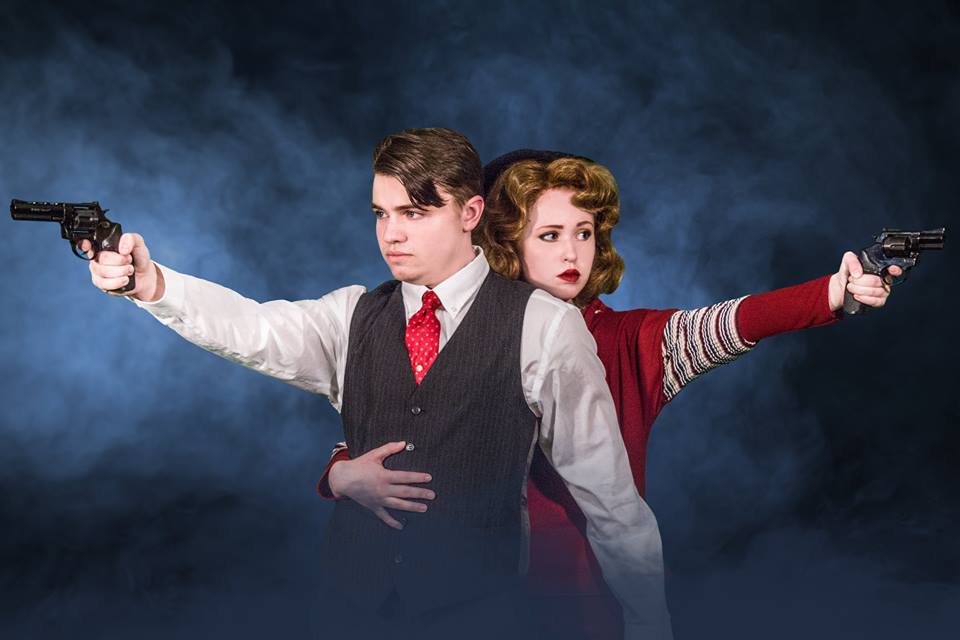
The musical “Bonnie & Clyde” – through June 25 at Buck Creek Players – opens with our titular characters dying from a rain of bullets on a Louisiana road in 1934. But this historical fact is not what is important in this show by Ivan Menchell and Don Black with music by Frank Wildhorn of “Jekyll & Hyde: The Musical.” We aren’t given the gore of their story; this play is an exploration of what made a young man and woman from Texas into the Romeo and Juliet of Depression-era crime.

Bonnie and Clyde musical publicity shot
Joseph Massingale and Annie Miller as Clyde Barrow and Bonnie Parker in the musical “Bonnie & Clyde” presented by Buck Creek Players.

After the opening tableau, we turn back to see a boy – young Clyde Barrow (Jordan Anness), a child of the West Dallas slums, become a career criminal at 12 and aspire to outshine the Roaring Twenties’ outlaws. We also meet a girl – young Bonnie Parker (Lauren Sciaudone), whose family’s hard times landed her and her mother in West Dallas, but she still plans to make it big one day in Hollywood.

These kids grow to be adults (Joseph Massingale and Annie Miller) in a world of dust and hard times – at one point our couple robs a bankrupt bank. Clyde is the only one who takes Bonnie’s dreams seriously, so they fall in love so deeply that even his stays in jail can’t keep them apart. As she joins him on his “jobs,” Bonnie gives up on the movies and aspires to fame in the pages of true-crime magazines and having her poetry published.

Meanwhile, Clyde’s brother, Buck (Levi Hoffman), gets in on the action with even his upstanding wife Blanche (Miranda Nehrig) drawn into the Barrow Gang. On the other side of the law, Deputy Ted Hinton (Jonathan Krouse), who had long been in love with Bonnie, joins in pursuit of the outlaws with Sheriff Smoot Schmid (James Hildreth) under the lead of Texas Ranger Frank Hamer (Kurt F. Clemenz).

The story presented neither demonizes nor glorifies the people involved, or their actions, but puts them in the context of their times and the contradictions that surrounded them – including the murderous thieves staying true to their families, going to meet them at the risk of their own safety. Some license is taken with the story, but it does stay surprisingly true to recorded events. A small video screen above the stage shows photos from the era, including mugshots, to underscore the truth of these scenes.

While rakishly handsome Massingale and charming beauty Miller excellently hold the center of the show in both voice and acting (and some resemblance to their real-life counterparts), supporting roles also shine. Nehrig’s Blanche telling Buck “You’re Going Back to Jail” is a wonderful highlight and an excellent example of the musical’s use of humor to balance the drama. Krouse gives us a heartbreaking glimpse of what Bonnie could have had in steadfast Ted. Molly Kraus is also noteworthy as Bonnie’s mother, Emma.

Director D. Scott Robinson’s passion for the show (which had a brief run on Broadway) is evident in the finished product.

Being a volunteer non-profit, BCP could “afford” to have the large enthusiastic cast and crew necessary to this musical, all “pros” in their own way. The effective yet elegantly simple stage set includes an exceptional replica of the front end of Clyde’s V-8 Ford, hand-built by set designer Aaron B. Bailey.

But the car’s fenders are clean and free of bullet holes. This is the story before that moment; a story of love and hard decisions in difficult times, the slow and steady progress of justice, and of running from the inevitable when the best you can hope for is to reach the end of the road together.

Find Buck Creek Playhouse at 11150 Southeast Ave. (Acton Road Exit off I-74); call 317-862-2270 or see www.buckcreekplayers.com.