Phoenix premiere: Search for understanding takes musical’s author ‘Home’

By John Lyle Belden

Nothing is what it appears in the Fun Home. Even the name disguises its purpose, being short for Funeral Home – but that doesn’t stop the kids who live there from writing it an upbeat commercial jingle. The house is immaculate, orderly and almost museum-like – an elaborate facade for the psychological chaos in its residents.

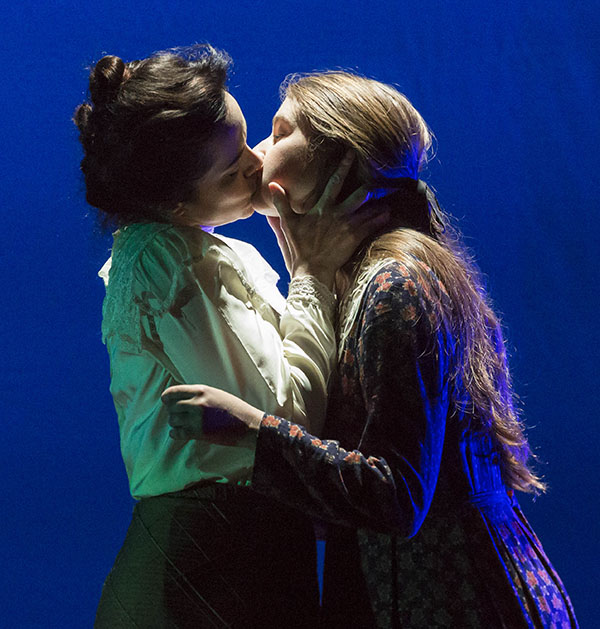
One of those kids, Alison Bechdel, grows up to be a popular queer cartoonist. As she reflects back on her unusual childhood and coming of age, she wants to write and draw it all as it really happened – not as she wants to remember it. That struggle plays out in the Tony-winning musical, “Fun Home” (based on her autobiographical graphic novel), making its Indiana premiere at the Phoenix Theatre in downtown Indy.

We meet today’s Alison (Cynthia Collins), young Alison (Amelia Wray) and, later, Alison in college (Ivy Moody).

The girl longs for attention from, and the teen connection to, her father, Bruce (Eric J. Olson), while helping mother, Helen (Emily Ristine), and brothers, John and Christian (Jacob McVay and Aiden Shurr), keep their home orderly. She finds herself having feelings she’s not sure others understand – she hates wearing dresses, she sees beauty in a muscular woman in short hair and a plaid shirt – unaware that in his own way, Dad understands.

How well he knew, and his true thoughts and feelings, Alison will never know.

In college, the young woman realizes what now seems obvious; she is a lesbian. She researches in books about sexuality, then learns hands-on from Joan (Teneh B.C. Karimu). After coming out to her parents, she gets their truth in return. And within weeks, her father is dead.

Our trio of Alisons excellently bring the story to life, especially charming Wray. Olson has a knack for making every role seem like it was written for him – this is no exception. Ristine perfectly portrays the longsuffering wife and mother, able to show so much in just an expression; her song, when Helen feels free to let her true feelings show, is the kind of moment that awards are given for.

Karimu presents the steadying influence of a good friend. And Brandon Alstott completes the cast as different characters, including Roy – a man who’s like an uncle to the kids, and much more to Bruce.

It’s easy to ride along on this emotional journey, because Alison isn’t the hero of her story (and neither can her father be, no matter how much she wishes it), she just wants to understand what makes her feel so different from the rest of the world. She’s still the girl who wants her Dad to lift her up, and through her search lifts him to examine the facets she can’t see clearly, no matter how hard she tries. She sees in her parents so many opportunities lost and abandoned, wondering what that bodes for her.

For all who feel different – maybe “queer” in either the traditional or LGBTQ sense – this show (presented in a single movie-length act) is highly recommended. Is it “fun”? Hard to say, but it can certainly feel like home.

This musical opens the final season at 749 N. Park Ave. (corner of Park and St. Clair) before the Phoenix moves to its new downtown location. It runs Thursdays through Sundays through Oct. 22. Call 317-635-7529 or visit www.PhoenixTheatre.org.

What’s so funny about peace, love and misunderstanding?

By John Lyle Belden

Anton Chekhov called his 1895 play, “The Seagull,” a “comedy in four acts” – which makes one wonder about Russians’ sense of humor.

But the play, adapted and directed by Casey Ross and presented by her Catalyst Repertory company – shaved down to two acts (one-two / intermission / three-four) – does have some light moments. Good drama always has its share of humor, and its “comic” elements are further reflected in an almost Shakespearean level of unrequited love among the characters.

The setting is a peaceful rural Russian estate, with its nice house belonging to aging civil servant Pyotr Sorin (Dennis Forkel) and a lake, near which his nephew Konstantin Treplev (Taylor Cox) presents a play he has written, starring his girlfriend, local girl Nina (Ann Marie Elliott).

Treplev sees himself in the shadow of his famous actress mother, Irina Arkadina (Nan Macy), and her popular friends. “I have no discernible talent,” he laments. But to prove himself, he is determined to write a “new form” of theatre, simultaneously rebelling against and surpassing the great Arkadina. Before an audience of locals, family and his mother’s guest, famous writer Boris Trigorn (Thomas Cardwell), the premiere flounders thanks to Treplev’s abstract symbolism – inspiring heckling from Arkadina – and Nina’s amateurish acting.

Later Trigorn flatters Nina, encouraging her dream of becoming a professional actor, and winning her away from Treplev. Meanwhile, beautiful-in-black Masha (Emily Bohn) is in love with Treplev, while poor schoolmaster Medivenko (Bradford Reilly) is in love with Masha. Paulina (Kyrsten Lyster) is in an affair with Yevgeny Dorn (Craig Kemp), a kindly doctor with a song in his heart, but she is married to very unromantic estate caretaker Ilya Shamrayeff (Anthony Nathan).

While good acting is essential to any play, the presentation of these characters is all Chekhov has given us – no wild action or deep mystery. Fortunately, Ross knows some very talented actors.

Cox is great at playing the tortured soul, and he has plenty to work with here. A hundred-twenty years later, even in Russia, Treplev would have medication and perhaps a therapist to aid his issues. In this world, he must wade through on his own with little help from his mother – she brushes off his suicide attempt as a silly phase, afraid to leave the limelight world that is the only place she feels happy. Macy turns on the charm, while showing the depth of her character’s shallowness.

Elliott is brilliant as usual, mastering not only all the subtle facets of Nina, but managing to act “bad” in an entertaining way. Cardwell reveals a man wrestling with the life his genius has given him – “I have no rest from myself” – but still subject to base desires. In one of the play’s most famous scenes, he presents the idea of “destroying” the young woman, saying it directly to her. But blinded by her pursuit of fame, Nina allows it to happen, not realizing until it is too late what she has become.

And a shout out to Nathan for nearly stealing scenes with Shamreyeff’s socially clumsy moments, and for making the death of the title bird more funny than it should be.

So: When you get what you’ve been chasing after – or what you settled for – is it worth it? That would be the thematic question at work here, and while the answers aren’t definitive, they do feel honest to the harsh world we live in, wherever we are in time or on the globe. And when the circumstances permit, we can get in a laugh or two.

“The Seagull” has performances Sept. 15-17 and 22-24 at the Grove Haus, 1001 Hosbrook St., near Fountain Square. For info and tickets, visit Facebook.com/CatalystRepertory or the company’s website.

IndyFringe: ‘Jubilee in the Rear View Mirror’

By John Lyle Belden

These things happened.

We must never forget that. These things happened.

Jubilee, Mississippi, does not exist, and “Jubilee in the Rear View Mirror,” the short drama by Garret Mathews that had a run at the recent IndyFringe festival, is fiction, but racial strife and murderous bigotry in Mississippi in the 1960s were real. These things happened.

Kates (portrayed by Donovan Whitney) represents the various college students – black, like him, or even white – who volunteered as civil rights workers, helping disenfranchised Southern blacks to register and vote. People who put up with derision, verbal and even physical attacks, from white residents who declared them “outside agitators” and an enemy to society. People who landed in a Southern jail cell, like Kates, speaking on a college level with a cellmate who barely finished high school, only adding to the layers of difference between them, yet trying to hard to bridge.

These things happened.

Buell (Clay Mabbitt) represents the Southerners who don’t feel things are quite right, but it’s the world they were born into. Perhaps they play along because it keeps you out of trouble. Perhaps they find other ways to act out at the world, like getting drunk and attacking a traffic light, landing in jail next to this nig… this outsider.

These things happened.

Tadpole (Sam Fields) seems like an unreal stereotype, but we all know someone like him, and in the rural South 50 years ago, there weren’t public services to care for people with mental challenges, but local folks would adopt them and take care of them. But what if your caretaker is in jail?

These things happened.

Spottswood (Kevin C. Robertson) represents the face under the KKK hood, the men invested in the racist status quo, who didn’t even see non-whites as human. Men who not only defied the outsiders, but reveled in the fact that they could kill them, and likely never face justice.

These things happened.

The jail Guard (Dustin Miller) represented the common go-along/get-along citizen. They just don’t want trouble, and really don’t feel comfortable with strangers coming in and upsetting things.

These things happened.

These actors, under the direction of Susan Nieten, do an excellent job of breathing life into these archetypes, making them human – all human – and standing before us, bringing the arguments and ideas of the time to life, presenting “all sides” better than the bluster of a present-day politician reveals. They bring to life Mathews’ imagined scenes, based on numerous interviews of people who were there, in real Southern towns.

These things happened.

And when you see this show, wherever it next gets staged – and you should – even with a different cast and director, and you see what its events lead to, remember:

These things happened.

For information on the inspiration for “Jubilee” visit Mathews’ website, www.pluggerpublsihing.com.

IndyFringe: ‘A Fatal Step’

By John Lyle Belden

How can I add to all the praise heaped upon Jill Vice, the star of the one-woman noir, “A Fatal Step”? Let’s just say it’s well deserved.

Vice performs all the characters in a dark tale suited to old-time radio or dime novels, but set in modern times. A beautiful woman whose devotion edges into manipulation commits everything to a man who finds more gentle and genuine affection with a plain-looking woman he works with; this will not end well.

Vice’s delivery maintains suspense while slipping in the punch lines, making for a thoroughly entertaining experience — and it doesn’t hurt that she’s as lovely and charming as her main character. Still, as she slips from persona to persona, she masters her expression to make all her roles, male and female, distinct.

Yes, add us to her fan club! John & Wendy encourage you to take “A Fatal Step” at 7:30 p.m. Sunday (Aug. 27) at the Phoenix Theatre, 749 N. Park Ave.

Festival info: www.indyfringe.com.

IndyFringe: ‘Canvas’

By John Lyle Belden

Standard disclaimer: I’ve known Casey Ross for years and love everything she does. So I can’t help but recommend this show, with a small caveat (see below).

“Canvas” is the third chapter of Ross’s trilogy that began with “Gallery” and continued with “Portraits” – both past Fringe shows. If you haven’t seen them, this play is still easy to follow, and a quick synopsis of the first two is in the program.

The story again focuses on two artists, best friends Jackson (Davey Pelsue) and Frank (Dave Ruark). In the past, free-spirit Jackson leaned on solid academic Frank, but now their situation is reversed as Jackson, a successful painter, cares for Frank, who has partial amnesia after an “accidental” drug overdose.

Once again, they struggle to define their relationship as each deeply loves the other, but the fact that one is straight and the other gay further complicates their feelings and actions. Their friends try to help, but have been burned by dysfunctional relationships with these two and can only do so much.

There is dark humor, raw emotion, and – my one caution – a frank examination of suicide. No easy answers are given, though this play does draw the trilogy to a conclusion.

Between Ross’s knack for sharp dialogue and a solid job by the actors, this play has earned its place as one of the hottest tickets at the Fringe. Get them if you can for performances Saturday and Sunday, Aug. 25-26 ,at Theatre on the Square’s second stage.

Festival info: www.indyfringe.org.

IndyFringe: ‘Free the TaTas’

By Wendy Carson and John L. Belden

Even though it sometimes seems the whole world is pink, we still must understand that awareness of breast cancer — and all cancers — includes knowing that it affects real people, including those you know (or even yourself).

Set in an atypical breast survivors support group, this show touches on how various people deal with cancer in their lives. These women are trying to overcome their grief and be upbeat, but it is no easy task.

Miss Bettye (Sandy Lomax), the octogenarian leader of the group, is outright hateful, dismissive and rude to everyone, yet you sense she feels for them. While she insists on honesty in dealing with disease, she hides the fact they could soon lose their meeting place.

The members of the group range from a starry-eyed dreamer (T. Studdard), an overworked cleaner (Tamara E’lan G.), and a desperate woman just trying anything to get by (Georgeanna Anthony). The women are trying to support each other, but Bettye keeps them at each other’s throats more often than not.

Enter into this group the indomitable presence that it Bass (China Doll), so named because her fishing-obsessed husband thinks she’s his best catch of all time. Bass tries to get everyone back on track but is met with resentment and venom at every turn. Meanwhile, she masks her own pain with humor.

Can these women turn their personal drama into a loving and supportive environment?

As they open up their journals to share with each other (and us), the true beauty of this piece is revealed. Much of the play’s content is in fact based on actual people and events. Taken as a whole, this is a hot mess that transforms into a heart blessing.

At the end, there is a short talkback session for the audience and actors to discuss their own personal journeys.

Remaining performances are Saturday night and Sunday afternoon, Aug. 26-27, at the Firefighter’s Hall, corner of Mass. Ave. and St. Clair.

Festival info: www.indyfringe.org.

IndyFringe: ‘An Elegy for Peter Through’

By Wendy Carson

This show has been the most surprising of anything I’ve seen at this year’s festival. The title lends itself to a dour subject matter, which is further reinforced by the setting, the interior of a funeral home. However, once the show begins, all of that is thrown out the window.

The funeral directors are expecting a quick, simple service when a gaggle of children and teens show up carrying a large wooden frame and demand to offer their own eulogies for the departed.

The frame becomes a sort of time portal in which the actors are transported to the day that they first met the deceased. With the seven actors quickly slipping into and out of 13 different roles, it may seem like it would be confusing, but the cast pulls off this feat seamlessly.

The stories told are funny yet uplifting and make for a warm, pleasant feeling of satisfaction afterwards. This show is definitely a good counterpoint to some of the more intense shows at the Fringe; it will greatly help you to readjust your psyche, so you really should not miss it.

John’s note: This is one of the best shows of the Fringe, in my opinion. Director Ann Marie Elliott told us that she and the Savage At Last actors worked out the story themselves without an initial script, and they all do an excellent job of channeling their inner teens and tweens facing a life-changing experience.

One performance remains, 9 p.m. Saturday, Aug. 26, at the Theatre on the Square second stage.

Festival info: www.indyfringe.org.

Phoenix’s ‘Human Rites’ challenges

By John Lyle Belden

Indy’s Phoenix Theatre has embraced the edgy and controversial since its founding. Still, the new drama, “Human Rites,” by Seth Rozin, under renowned Chicago director Lavina Jadhwani, hits particularly sensitive subjects in today’s global culture – including how truly “global” a perspective can be.

The three-person cast of Rob Johansen, Milicent Wright and Paeton Chavis are total professionals putting in some of their best work. They help to humanize what turns out to be a contentious, eye-opening and challenging argument.

On an American university campus, Michaela (Wright), the college Dean, calls Alan (Johansen), one of her professors, into her office for a meeting. Through their conversation, we find that they once had a sexual affair, but the topic at hand regards complaints about an academic paper that Alan had one of his classes read – a paper, based on his years of research in Africa, that calls into question assumptions regarding female “circumcision” (also referred to as Female Genital Mutilation).

Being an African-American woman, Michaela is appalled at what she reads and challenges the paper’s findings. She also invites a native African graduate student, Lydia (Chavis), with the intent of having her conduct her own study on the topic. The young woman from Sierra Leone is surprised at this and reluctant for reasons of her own. She has much to say, challenging both American academics in the room, as well as all of us watching.

Rozin, who was present for the opening night reception, said the play’s assertions are based on actual research findings. But just as important in this drama is how we as Westerners react to, accept or challenge the data and opinions presented. Lydia’s own perspective calls into question how “civilized” we assume American cultural norms to be.

Since humans are complex creatures, the strong emotions sparked by the characters’ exchange include humor, with quite a few nervous and raucous laughs extracted from their situation. Though you might find yourself with a lot to think about and maybe a bit uncomfortable with those thoughts, this play is worth the challenge – and entertaining in its unconventional way.

Performances continue through Aug. 14 at the 749 N. Park Ave. (corner of Park and St. Clair near Mass. Ave.); call 317-635-7529 or see phoenixtheatre.org.

Indy companies expertly flesh out Richard III’s twisted skeleton

By John Lyle Belden

In 2012 came the stunning news of a human skeleton discovered under a parking lot in Leicester, England. It was the twisted body of what history and legend regard as a twisted soul, King Richard III. This setting opens the Catalyst Repertory/First Folio production of William Shakespeare’s play about the infamous monarch at the IndyFringe Theatre.

In what would be the last years of England’s Wars of the Roses between contesting royal families, King Edward IV is sick and dying. Richard, the Duke of Gloucester, is reviled for his crippled body, which brings on his sour attitude. The clever Duke decides if he can’t look like a hero to gain the crown, he’ll be the villain. But between him and the throne are George, Duke of Clarence; nobles faithful to Edward’s wife, Queen Elizabeth; and the child heir, Edward, Prince of Wales.

Some people are going to have to die.

Matt Anderson completely transforms into Richard, with the help of costume artist Linda Schornhorst (whose excellent work adorns the whole cast). This, coupled with Anderson’s complete control of his body and expressions, keeps him the focus of every scene. He leers towards the audience, proudly revealing to us his schemes. He lurks like a menacing vulture as his plans unfold. He contorts himself into whatever ingratiating pose will fool those around him as he continues grasping to take, then desperately hold power.

Carey Shea anchors the play as doomed Clarence, heroic Richmond and the archaeologist who bridges the gap between history and today. Jay Hemphill is charming as the Duke of Buckingham, Richard’s cousin and co-conspirator until he becomes cursed with a conscience.

Also notable are the women of the play, Allison Clark Reddick as Elizabeth; Christina Howard as Lady Anne, Richard’s unwilling bride (and a few scenes as Lord Grey); Nan Macy as the Duchess of York, Richard’s disappointed mother; and Casey Ross as Queen Margaret, widow of a previous monarch and bitter prophet.

The children – Dalyn Stewart as Prince Edward and Lex Lumpkin as his cousin, the Duke of York – are both sharp.

And kudos to Doug Powers, Matthew Socey, Ryan Reddick, Kevin Caraher, Matthew Walls, Mark Cashwell and John Mortell in various roles. Thanks to Glenn L. Dobbs’ direction and the play being adapted to two hours, in two acts, by Dobbs, Ross and Ben Power, it’s not hard to follow the sprawling cast of characters. (Richard has many of them killed, anyway.)

Plays like this are always apropos in an era of political turmoil, and performances this good are worth seeing at any time.

“Richard III” runs through July 9 at the IndyFringe Basile stage, 719 E. St. Clair (by the intersection of St. Clair, College and Massachusetts Ave.). See indyfringe.org for info and tickets.

Bobdirex’s ‘Notre Dame’ rings true

By John Lyle Belden

Upon hearing that Bob Harbin and his Bobdirex productions are staging “The Hunchback of Notre Dame,” a musical featuring the Alan Menken/Stephen Schwartz songs of the 1996 Disney animated film, you might wonder (as I did): Bob likes to go big and take chances, but didn’t the movie “Disney-fy” the Victor Hugo novel, making it too saccharine with an entirely-too-happy ending?

Take heart, purists. While there are a number of similarities to the animated version (and nearly all performed versions through the years have taken some liberties with Hugo’s text), this musical – originally produced in Germany by Disney Theatricals in 1999 – embraces the darker aspects of the story and doesn’t shy from its tragic elements.

This show effectively uses multiple members of the cast as narrators through the story, but most of that job falls to Clopin (Keith Potts), king of the Gypsies. We begin with how Frollo (Bill Book), the Archdeacon of Notre Dame cathedral in Paris, came to adopt and raise Quasimodo (Jacob Butler), a severely deformed young man who lives sheltered among the church bells, tasked with ringing them. With no living human friends, he talks to the bells, the Saints’ statues and his fellow grotesques, the Gargoyles (Curtis Peters, Matt Rohrer and April Armstrong-Thomas).

The annual Festival of Fools draws Quasimodo out into the church courtyard, where, after meeting beautiful dancer Esmeralda (Shelbi Berry), he is crowned by Clopin as “King of the Fools.” But this king is mocked rather than honored, and Quasimodo returns to his bell tower.

The gypsy girl’s beauty draws the notice of not only the Hunchback, but also the Captain of the Guard Phoebus (Logan Moore) and Frollo. The Archdeacon struggles to convert his carnal longings into a desire to save her soul, and decides that if he can’t make her pure in his hands, he’ll have it done by fire.

The result is a stirring story of struggle between the sacred and profane, and how the line blurs between them. An ever-present choir punctuates scenes with chants like Kyrie Eleison, completing the atmosphere of the well-built Gothic set. The show’s Disney influences give it energy and welcome touches of humor, but isn’t overdone.

Harbin has not let us down, as we get excellent performances from all, especially Book and Potts, each charismatic in their own way. Berry is stunning. And Butler gives an award-worthy performance as our unlikely hero.

Once again, Bobdirex has delivered a must-see show, with performances Thursday through Sunday (June 29-July 2) and July 7-9 at the Marian University Theatre, 3200 Cold Spring Road, Indianapolis. Thursday, June 29, all military members get in free, with discounts for their companions. For more information, call 317-280-0805 or visit bobdirex.com.