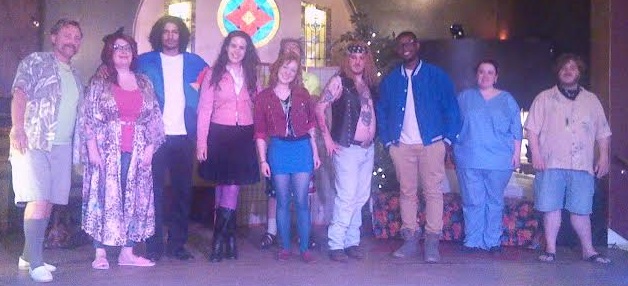
Review: Hitchcock, hilarity and ice cream

By John Lyle Belden

The downside to classic old films is, well, that they’re old. There’s a good chance you’ve already seen them, maybe more than once, or at least have heard about them so much that you know their plots, including the “spoilers.” This is especially problematic for mystery thrillers, which rely on you getting surprised by that twist near the end.

To keep them entertaining, the trick with such well-worn stories is how they’re told. Case in point: Patrick Barlow’s manic re-imagining of master of suspense Alfred Hitchcock’s classic, “The 39 Steps.” This London and Broadway hit is now playing on the stage of Carmel Community Players in the Clay Terrace shopping center.

The dramatic elements of Hitchcock’s movie are still there: In 1930s London, a man attending a performance by “Mr. Memory” meets a mysterious woman who insists she go home with him, then reveals she is being followed. During the night, the woman is murdered and the man is on the run, trying to clear his name. All he knows is that secrets are about to be taken out of the country, and that the espionage involves a master spy with part of his finger missing and something called “The 39 Steps.”

So, that’s the plot, but even if you know all the answers, it’s still worth both your time and your dime (actually a bit more) to see Barlow’s version, brought to life by central Indiana actors Jay Hemphill, Libbi Lumpkin, Neal Eggeson and Craig Kemp, under the direction of Lori Raffel.

The delivery of the story’s scenes rely more on slapstick than suspense, combined with wink-to-the-audience use of stagecraft, where chairs become cars; trunks become trains; curtains and windowshades just hang in midair where needed; and a supporting actor inhabiting two roles slyly converses with himself.

Eggeson and Kemp are identified in the program only as “Clown 1” and “Clown 2,” nimbly taking on all the roles of people encountered by our hero, Richard Hannay, played dashingly by Hemphill. Both Clowns bring the funny as they propel the plot forward, including Eggeson’s gender-bending turn as a Scottish inkeeper’s wife, Kemp’s entertaining portrayal of Mr. Memory and the goofy chemistry between them as the thugs in pursuit of our hero.

Hemphill plays a Hannay who is at times blusteringly confused as to what is going on, and at other moments a little self-aware that he’s the hero of the play, balancing this dance with our expectations and the fourth wall perfectly.

Lumpkin – a fierce balance of beauty, brains and bravery – fills the pumps of both the murder victim and the woman Hannay ends up handcuffed to during one of his escapes. Even at her most irritating and irritated at the other cast members, she never loses her charm with us.

Aside from our foursome, credit must also be given to stage manager Mark Peed, whose necessary interventions add to the magic rather than distract. And watch for references to other Hitchcock classics hidden in the story.

Another fine feature at CCP is the availability of ice cream at the concessions during these hot summer weekends. “Alfred Hitchcock’s The 39 Steps” plays through Sunday at 14299 Clay Terrace Blvd., Suite 140, Carmel. Call 317-815-9387 or visit carmelplayers.org.

Review also in July 30 edition of the Greenfield Daily Reporter.

Games: The apple doesn’t fall far from the, um, Apple

Consider this
Consider this “Cards FOR Humanity,” the game that launched a whole genre of party games. — Manufacturer image

By John Lyle Belden

In the last couple of years, people have gotten caught up in the outrageousness of a simple card game. Folks who wouldn’t otherwise bother with bringing out a game box at a party, who left card games like rummy or Uno behind with their childhood, found themselves eager to be both amused and shocked by Cards Against Humanity.

The concept is easy to grasp. Players all draw from a deck of cards that each have a person, place or thing named on it. One player, who is the “judge” for that round, draws and reveals a single card from a deck of cards printed with phrases with fill-in-the-blanks. The other players each give the judge a card (face down) that might fit the topic card. The judge then decides which player gave the best or most amusing answer, and the next round is played with a new judge. As the title “Cards Against Humanity” suggests, many cards, which include sexual and scatological references, are as disturbing as they are funny.

But it might surprise some CAH fans that this style of party game is hardly a new concept, best exemplified by the 1999 hit Apples to Apples. Easy to find in stores, with thousands of cards in its licensed variations – and more safe to play with kids – the game has players playing their Red Apple cards, with nouns, to match Green Apple cards, with adjectives. Of course, with devious enough players, Apples to Apples games can also push the boundaries of political correctness. For instance, you could play “Adolph Hitler” on “Visionary” – accurate, though no one cared for his visions. Our favorite winning combo in a game I played was “Helen Keller” for “Touchy-Feely.”

The enterprising dark souls who came up with CAH (which can also now stand for Crabs Adjust Humidity, a renegade version of the game now making the rounds) were not alone in using the Apples template to set up their game. It’s illegal to copy directly, which means you have to get inventive:

  • Crappy Birthday” declares the rotating judge to be the birthday boy or girl, and the single set of cards are potential bad presents, of which the receiver must pick the worst. Since one person’s get-that-away-from-me is another’s I-want-that-now, the game now has a “Happy Birthday” variant.
  • Snake Oil” has the judge drawing a card that is his or her persona – a cheerleader, undertaker, or Santa Claus, for example – and the others use their cards to come up with innovations they need to sell. The anonymity factor is taken out, but if a group are good enough friends, hopefully one won’t be too guilty of playing favorites.
  • The Big Bang Theory Party Game” includes quotes and odd things said on the hit sitcom, played out in Apples to Apples style. No actual knowledge of the show is necessary; this is not a trivia game. The game mechanics add a “Bazinga!” card that changes the goal card that everyone played their cards to match, and also adds scoring chips that allow the second-, third- and fourth-best answers to also get points, rather than just choosing only one winner each round.

These are just a few of the variations. Note that none of the three above or CAH (either version) are by the same company that produces Apples to Apples. Personally, I’d recommend getting the big “apple crate” version of the original game to get yourself and your friends hooked. Then, try the others. If your tastes and friends are like “R”-rated movies, go for CAH. Perhaps pick up the Big Bang version, and use its scoring chips to make Apples more interesting.

Only one warning: These games get so addictive, your party guests might lose all track of time until every card in the box is exhausted. You better get extra snacks.

Review: Where there’s “Smoke,” there’s a mighty fine show

The cast of Beef & Boards Dinner Theatre's
The cast of Beef & Boards Dinner Theatre’s “Smoke on the Mountain: Homecoming,” running through Aug. 16. — Beef & Boards photo

By John Lyle Belden

For regular patrons of Beef & Boards Dinner Theatre in northwest Indianapolis, just saying, “There’s a ‘Smoke on the Mountain’ show!” is enough to get many scrambling to contact the box office.

The popular original off-Broadway show centers on a gospel-singing family putting on a “sing” at a rural North Carolina church in the 1930s. Aside from seeing the interpersonal drama among the Sanders clan and sharing a few laughs, the audience is treated to a series of old-time hymns and gospel tunes, with the cast playing an array of instruments.

The sequel, “Sanders Family Christmas,” has the family returning to Mount Pleasant Baptist Church for a holiday sing in 1941, the last show before the Sanders’ son goes off to war.

The present production, “Smoke on the Mountain: Homecoming,” takes place in late 1945, with the war over and young Dennis (Will Boyajian) back with the family, following through on his service as a chaplain and a lifelong call to take the pulpit as the Mount Pleasant minister.

The departing pastor, the Rev. Mervin Oglethorpe (John Vessels), responded to a request to open a church in Texas and will leave the next day, taking his very pregnant wife, June (Sarah Hund), the Sanderses’ elder daughter. Burl and Vera Sanders (Bob Payne and Pam Pendleton) still have daughter Denise (Christina Rose Rahn), Dennis’ fraternal twin, now married with twins of her own, as well as Burl’s troubled brother, Stanley Sanders (Brian Gunter).

They are hosting one more sing before the Oglethorpes depart, but it becomes apparent that there are still a few issues to work out.

It helps that most of the cast is the same as past B&B “Smoke on the Mountain” productions, especially Vessels as the emotional and hyperactive Brother Mervin and Hund at her comic best as simple June, who provides the family band’s percussion, sometimes in hilariously inventive ways, and signs rather than sings — though some of her gestures might confuse any deaf audience members who happen by the church.

Boyajian and Rahn make their B&B debuts but manage to fit right in as though they had always played the Sanders twins, especially when circumstances force them to re-enact a song from when Dennis and Denise were very young.

It’s not all comedy; be prepared for some very serious moments of testimony and a lot of talk about Jesus. But this is what comes naturally in a musical with a song list that looks like one from a small-town Sunday school.

In fact, especially when Dennis or Stanley recall their darkest hours, it’s easy to forget that these are fictional characters. But the spirit (or Spirit, if you believe that way) of the play stays true to the memories of those of us who ever attended a little church in the backwoods -– or a hometown congregation anywhere.

One hopes that playwright Connie Ray would eventually see fit to have the Sanderses go see June and Mervin for a Texas-sized gospel sing, but for now we can enjoy witnessing the “Homecoming” daily except Mondays through Aug. 16 at 9301 N. Michigan Road, near the Pyramids. Call 317-872-9664 or see beefandboards.com.

– – –

Review also appears in the July 23 edition of the Greenfield Daily Reporter.

Review: Say yes to the dresses

The Cast of Theatre on the Square's "Love, Loss and What I Wore" by Nora and Delia Ephron, playing on the TOTS Second Stage through Aug. 1 -- TOTS photo by Abdul-Shaheed
The Cast of Theatre on the Square’s “Love, Loss and What I Wore” by Nora and Delia Ephron, playing on the TOTS Second Stage through Aug. 1 — TOTS photo by Abdul-Shaheed

By John Lyle Belden

A local production of “Love, Loss and What I Wore” by Nora and Delia Ephron returns to Indianapolis, now playing at Theatre on the Square (the first production was a couple of years back at the Phoenix) and is, again, a funny and heartwarming little show about how our wardrobe links to our memories.

The play is mostly a set of monologues performed by five women. In the center is Adrienne Reiswerg as Gingy, the central recurring character who has lived a full life and, to remember it, has made drawings of the various dresses and outfits she has worn along the way. As stage manager Stacy Ricks hangs the drawings up behind her, Gingy relates the story behind each garment.

In addition, Rhoda Ludy, Miki Mathiodakis, Lucinda Phillips and Bridget Schlebecker portray numerous characters – mothers, daughters, sisters, fiances – who remember boldy and fondly a certain dress, or bra, or shoes, or even finding a unique purse.

The delivery brings out a lot of laughs – “You’re not wearing that, are you?” – as well as a few tender moments. It will no doubt also stir up some memories of your own favorite item.

You don’t have to be female or fashion-obsessed to love this show. The well-crafted script is in very able hands on the TOTS Second Stage. But if clothes are your thing, you simply have to see it.

This production runs through Aug. 1 at 627 Massachusetts Ave.; call 317-685-8687.

Review: Casey Ross Productions’ “Stoops” conquers

Cast of Casey Ross Productions' "She Stoops to Conquer," Friday, June 19, 2015 -- photo by John Belden
Cast of Casey Ross Productions’ “She Stoops to Conquer,” Friday, June 19, 2015 — photo by John Belden

By John Lyle Belden and Wendy Carson

It’s too easy to call the Grove Haus, the funky former church building in Indy’s Fountain Square district where Casey Ross puts on her plays, the “Groove House” – because Miss “Uncanny Casey” is so, well, groovy.

And speaking of mildly-outdated but still appropriate words, Ross takes the 1700s Oliver Goldsmith comedy “She Stoops to Conquer” and gives it a groovalicious update.

Like the 18th century, the 1980s were a time of big hair, regretful fashion and wacky music. In the meantime, Florida has become synonymous with rednecks, stupidity and all manner of bizarre behavior. Add these two elements to the script of the classic and slightly bawdy play and you have CRP’s latest entertaining diversion. The tale of arranged marriages (including one between two cousins), mistaken identities, besotted or scheming individuals, and overall confusion meshes well with the chosen setting.

Dick and Dorothy Hardcastle (David Malloy and Ross) own both a home and a motel, sufficiently tacky that one can’t tell one from the other. Dick wants charming daughter Kate (Ann Marie Elloitt) to check out his old friend’s son Marlow (Max Jones), whom they haven’t met, as a potential husband; while Dorothy wants her drunken slacker son Tony (Taylor Cox) to marry his cousin (and Kate’s bestie) Constance (Veronica Orech) to better secure their property, especially the precious jewels that Constance inherited and Dorothy is holding onto as dowry.

Marlow arrives with best friend Hastings (Tyler Gordon), who has cultivated a romance with Constance. From here on, the plot gets twisty, as Tony pranks Marlow into thinking the Hardcastle home is the motel, so the young suitor treats Dick like the hired help and pines for Kate, thinking she is a just a maid and not the lady he was supposed to meet – the girl, in turn, plays along for comic situations that would do the Bard proud. Meanwhile, Hastings and Constance conspire to run away to marry, enlisting Tony’s help in getting the valuable jewels. Everything goes wrong, and, this being a comedy, everything goes right in the end.

The play not only makes use of the small stage at the head of the house, but also the central floor area, with actors occasionally sitting with and talking directly to the audience. This intimate staging not only helps us connect with the action, but also precludes the need for sticking microphones to the actors. This is a refreshing change from most Indy-area community theatre. However, in this environment, enunciation and vocal projection are more critical, and any failings are more noticeable. Opening night only had a few unclear lines, which no doubt have been worked on during this intervening week, and the story was easy to follow.

The stage set is appropriately tacky, with a couple of in-joke posters, and Ross’s sound design includes a lot of snippets of ’80s hits, keeping the mood light and fun.

Under the direction of partner “Fedora Dave” Matthews, Ross makes a welcome return to the boards, exuding gleeful maternal malevolence under a burgundy wig. Elliott is 100 percent pure-cane sweetness; Cox does slackerdom proud; Gordon is suave and valiant; Orech is comically sharp; and Molloy is fun as the blustering patriarch. Also notable is John Garlick, who comes in late in the play as Marlow’s father. Jones does great at his complex character, having to come off as naive, shy and buffoonish, but then win us over as the romantic hero at the end (Elliott-as-Kate’s kind, forgiving nature helps).

The setting doesn’t translate 100 percent, but is close enough when one considers Southern society can be at least as idiosyncratic as Olde England. One reference to pounds instead of dollars sounds out of place, but can be forgiven.

The show has one more weekend, Friday through Sunday at 1001 Hosbrook St. Tickets are $15. Get info at facebook.com/caseyrossproductions and go get your groove on.

Review: Bobdirex’s “Jesus Christ Superstar”

From left, Patrick Clements, Joe Doyel and Julia Perillo as Jesus, Judas and Mary Magdalene in Bobdirex's production of
From left, Patrick Clements, Joe Doyel and Julia Perillo as Jesus, Judas and Mary Magdalene in Bobdirex’s production of “Jesus Christ Superstar.” — Photo by Zach Rosing

By John Lyle Belden

Producer and director Bob Harbin, a/k/a Bobdirex, is notable for bringing shows that are new and/or rarely-seen in Indy, and always thought-provoking. So, as he now presents the Andrew Lloyd Webber and Tim Rice standard “Jesus Christ Superstar” – which has featured rocker Sebastian Bach, cinema-version star Ted Neeley and others over the last decade or two – I had to ask, as I prepared what I would write here: What new thing(s) does Bob feel he is showing us with his “Superstar”?

So I asked him directly, and he generously responded:

“I’ve seen a couple of those local productions, and always felt like little attention had been paid to casting people who could really sing the leads – I felt like I was being yelled at when I think the folks were simply trying to hit the notes. I’ve wanted to investigate this show, but promised myself I’d never do it without the voices.
“I also wanted to do something that didn’t feel like it had to move to another time zone to make it relevant, and cast it with the best folk with a blind eye to gender, color, size, etc., which is something that’s important to me every time.
“I really believe in the abilities of our local talent – we just have to pay attention to where we put them, and sometimes wait until the right ones are available. I love that the performance you’ve just seen and that you’ve just enjoyed was done by someone who could be your next-door neighbor.”

Well, he nailed it on the voices. In “Superstar,” playing Thursday through Sunday and June 19-21 at the former Civic Theatre stage at Marian University, Joe Doyel sings with all the necessary power needed for the lead role, Judas Iscariot.

(For those unfamiliar with the plot of Webber and Rice’s musical Passion Play, much of the story is told from the point of view of Judas. His frustration at, and arguably misunderstanding of, Jesus’ actions at the end of his ministry lends a thought-provoking perspective without compromising the sacred aspects of the Gospels. We also see Jesus’ frustration at followers who don’t seem to grasp his purpose, Mary Magdalene’s responses to her master’s fading morale, and the Jewish leaders – driven by politics as much as faith – conspiring against what they see as a “dangerous” man.)

For the other male lead, Patrick Clements embodies the full range of feelings – gentle, irritated, consoling, angry, despairing and humbled – necessary to portray Jesus. He never overdoes it, which would bring too much attention to the actor rather than the Christ he represents, but you still sense the authority he brought to his red-letter biblical utterances.

But this play’s biggest revelation is 17-year-old Julia Perillo as Mary. Her sweet, strong voice is tested but doesn’t break, providing the necessary feminine counterpoint to Judas’ proud bluster. When she sings of her beloved Christ, “he scares me so,” we shudder with her.

In another vocal coup, Harbin has brought Michael Lasley – usually encountered as the “voice of God” who tells us to silence our cell phones at the Booth Tarkington Civic Theatre – onto the stage as Caiaphas to rumble with astounding clarity all of those low notes.

Ty Stover is excellently cast as Pontius Pilate. We’re used to seeing him in lighter roles, but it’s easy to see how he can still do such an iconic dramatic role in his sleep (which he doesn’t – he was totally awake, I’m sure).

The role of King Herod, the closest Webber and Rice come to comedy relief, is played flamboyantly by Danny Kingston. Though the performance verges on “Queen Herod,” he still makes it work.

Overall, Harbin’s direction brings us the familiar story and songs in a highly competent manner that holds our attention, aided by Kenny Shepard’s choreography and a simple set with laddered structures that take advantage of the roomy stage. He also makes the decision to not soften the ending: What happens beyond the cross is left to the viewers and their faith.

Whether you’ve never seen this classic musical or sat through it a hundred times, this production is worth attending. Find the stage at 3200 Cold Spring Road, Indianapolis. Get tickets at 317-280-025 or bobdirex.com.