IndyFringe: ‘Intrusion’

This show is part of the 14th Annual Indianapolis Theatre Fringe Festival, a/k/a IndyFringe, Aug. 16-26, 2018 on Mass Ave downtown. Info, etc., at www.IndyFringe.org.

By John Lyle Belden

In an America where one of the horrors of civilization is believed to be long vanquished, an insomniac looks across the street at the nearby hospital to see an injured woman enter. Curious, she goes closer and hears a word that chills her — Rape!

In the utopia of “Intrusion,” (now also an Off-Broadway show) written and performed by Qurrat Ann Kadwani, there has been no report of sexual assault in 20 years. This first person — a bystander who becomes an activist — is one of eight characters Kadwani presents coming to terms with this new world that is starting to feel like the old one — a/k/a the one we unfortunately live in now. Among them, a reporter feels the chill of getting the story of a generation, a prosecutor worries the rape trial will be a career killer, a psychologist tries to address such an emotionally fraught topic with clinical detachment, a politician laments that this is coming up during an election year, and a third-grader just wants to be told what’s going on.

Can something so insidiously imbedded in our culture be “cured, like polio”? Kadwani easily slips from one persona to another, as the mood gets more and more uneasy. A lone “outlier” rape accusation inspires more women speaking up. Many more. While some are concerned for public safety, still others don’t like these events upsetting — perhaps negating — the status quo they invested so much in. The fragile nature of our social construction is revealed in a popular game.

Kadwani brings us an excellently written and executed one-woman show. My more critical inner voice couldn’t help but consider that this was just one more “issue play.” The stories of personal pain, the stark statistics of the pervasiveness of sexual assault in America and worldwide — I have heard them all before, so many times. But to our horror and shame, that fact is very much the point.

Make this New Yorker feel welcome; performances are in the first floor of the Firehouse union hall, 748 Mass Ave.
IndyFringe: ‘Beneath the Surface’

This show is part of the 14th Annual Indianapolis Theatre Fringe Festival, a/k/a IndyFringe, Aug. 16-26, 2018 on Mass Ave downtown. Info, etc., at www.IndyFringe.org.

By John Lyle Belden

When you first see what is going on — kids barely out of middle school coming on stage to present a show they developed about difficult issues they think about and face — I couldn’t help but mentally lower the bar and pray this wasn’t like that bad SNL skit of naive kids presenting awkward “awareness” scenes.

Now I must apologize to them, and ask that you, too, give this show a chance. Beneath the Surface of “Beneath the Surface,” by Sugar Creek Players Youth Troupe, is earnest searching for understanding, and expression of what the world is like when you are 14 or 15, no longer child but not quite adult — you remember, right? What we see is bravery beyond the tamping down of stage fright.

Budding comic Liberty Owens is “Conscious,” the narrator and facilitator of our look into four archetypal characters: Veronica the young activist, Alex the “jerk,” Jasper the poet (who is on the Autism spectrum) and Juana the Mexican immigrant. Drawing conclusions about them yet? Please note the title of the play — yes, these kids have layers.

I ask you cooperate with Conscious — she’s a little silly, and prone to telling groaner-jokes (could you do better at her age?) — but she is only helping us understand our subjects as they strive to understand themselves, and each other. So when she asks which person’s story you want to see continue, speak up and suggest someone; they are all intriguing, and sharply presented with earnest emotion.

Just as the film “Eighth Grade” is now bringing this crucial point in our lives to the national conversation, you get to see something of this in person, developed and performed by local teens. Note some hard issues are addressed, and it doesn’t have an artificially happy end — in fact, as in the real world, struggles continue. But if you came to see a Fringe show, here’s a doggone Fringe show. My troubled teen self of years past salutes them.

Isabella de Assis-Wilson as Juana is joined by Sara Adams (Veronica), Terran McCarty (Alex) and Evan Baldwin (Jasper) for the Tuesday, Aug. 21, performance. Remaining performances feature Sonora Kay (Veronica), Sara Adams (Alex) and Austin Coon (Jasper). All are on the main stage of the District Theatre (formerly Theatre on the Square), 627 Mass Ave.

IndyFringe: ‘Hers is the Head of a Wolf’

This show is part of the 14th Annual Indianapolis Theatre Fringe Festival, a/k/a IndyFringe, Aug. 16-26, 2018 on Mass Ave downtown. Info, etc., at www.IndyFringe.org.

By Wendy Carson

First of all, let me tell you that this show is about Schizophrenia. It’s initial scene makes that unclear and there is the ambiguity of the situation where it could be about something else (read: lycanthropy). Now that you know this, lets talk about the show.

This show is powerful and amazing. It does a great job of giving insight to the real struggle of a victim of this disease and those around them who are either trying to help them or just be a part of their life.

I was especially impressed by the portrayal of Danny, who starts as her tutor and then begins to turn into a boyfriend. His character is not white-washed wholesome nor entirely cut-and-dried sympathetic. He gets angry and loud at times but is tender and concerned at others which is a much more realistic look at how one would be in the real world.

The therapist, Dr. Hamilton, is genuinely concerned and clearly doing his best to help guide his patient through learning to cope with this debilitating disease. However, even at his most earnest, his voice and advice does sound a bit patronizing.

Then of course, there is our heroine(?) Elise. She literally strips herself bare and exposes her fear, vulnerability, and sheer revulsion at her plight. She struggles to overcome her demons (whose voices we eventually hear for ourselves). She didn’t ask to be like this. She doesn’t want to be like this. She just wants to feel safe for once in her life.
What becomes of each of our players is for you to witness and by all means, you really should witness this. Just know that the show is gut-wrenching and can be overwhelming (much like the condition it portrays).
One performance remains, 9 p.m. Tuesday, Aug. 21, at the IndyFringe Indy Eleven Theatre, 719 E. St. Clair, just east of the Mass Ave. and College intersection.

IndyFringe: ‘Atlanta Burning, Sherman’s Shadows’

This show is part of the 14th Annual Indianapolis Theatre Fringe Festival, a/k/a IndyFringe, Aug. 16-26, 2018 on Mass Ave downtown. Info, etc., at www.IndyFringe.org.

By John Lyle Belden

“I do what I must, rather than what I wish,” laments Gen. William Tecumseh Sherman, a Union commander during the Civil War (in)famous for his scorched-earth March to the Sea in 1864, an effort to shorten the war (which did end the next year) by bringing its horrors to the civilian population of Georgia.

Playwright Lance Sherman Belville, a descendant of the general, presents an insight into the man’s thinking as he relates his plans to a trusted assistant and his general staff shortly before his fiery assault on Atlanta. We learn of his past relationship with Robert E. Lee (a classmate at West Point), his longing for his lost son, and his desire to not repeat what he saw as the greater tragedy of the siege of Vicksburg.

The show’s director, Lynn Lohr, plays the Major who Sherman uses as his sounding board, his “fool” to tell him what is wrong with the plans he is nevertheless determined to execute.

We also have a young Private, portrayed by Connor Buhl — who also plays a Union soldier in reenactments and at Connor Prairie. This, plus being the only player in full period uniform, makes him the most interesting and compelling character. He plays harmonica, and engages the audience without breaking character before the show, leading us in songs of the era.

The playwright plays his great-great uncle, holding and reading from the script that he (as Beville) says he is “still revising.” It’s a curious and brave choice, but he often stumbles over his own words, marring what is otherwise a highly-recommended living history lesson.

If you can ignore the papers in the playwright’s hand, or at least see them as reports or correspondence or maps in Gen. Sherman’s, sit back with some hardtack (provided) and get a new perspective on the story you may only know from a long-ago high school lesson or scene from “Gone With the Wind.” Performances are at the Indyfringe Basile (main) Stage at 719 St. Clair St., near the intersection of Mass Ave. and College.

IndyFringe: ‘Act VI Scene I (Shakespeare and Zombies)’

This show is part of the 14th Annual Indianapolis Theatre Fringe Festival, a/k/a IndyFringe, Aug. 16-26, 2018 on Mass Ave downtown. Info, etc., at www.IndyFringe.org.

By Wendy Carson

From the title, you would expect this to be something like a Shakespearean version of “Shawn of the Dead.” However, nothing could be further from the truth. The play is introduced by The Bard himself (who also returns to narrate the various scene changes) without explanation as to its provenance.

We are presented with two young lovers being secretly married amidst the protestations of their families. When the Priest asks if anyone has reason for the two not to be wed, an armed stranger bursts in and bids them to bar the door as the dead have risen and are attacking the town. The story then follows the next four weeks in the lives of these four characters. Their personal relationships, the fight among their inner demons, and their ultimate fight to survive in this new situation.

While the plot may sound like a zany re-hash of various other books, TV shows and movies, it is played with all of the austerity that one would expect in a play written by Shakespeare. Even though the dialogue is pure Shakespearean English, it translates well to the story and makes the style so much more accessible to a modern audience.

I would highly recommend bring teens and children to see the show to get a taste for the style of plays before they actually dive into the actual works of Shakespeare. Who knows what this sort of project could inspire?

“Act VI, Scene I” is presented by The Lord Chamberlain’s Men at the District Theatre (formerly Theatre on the Square), 627 Mass Ave on the secondary Cabaret Stage.

IndyFringe: ‘They Shall Take Up Serpents’

This show is part of the 14th Annual Indianapolis Theatre Fringe Festival, a/k/a IndyFringe, Aug. 16-26, 2018 on Mass Ave downtown. Info, etc., at www.IndyFringe.org.

By Wendy Carson

When I went into this show, I expected a story about the wild and crazy acts of the notorious “Snake-Handling” Churches. However, I got much more than I was prepared for.

The story focuses on one young girl who drives over two hours in order to attend services at the church for the past eight weeks, and is feeling the desire to “Stand up front” (i.e. hold the snakes). The tale of how she came to be here is bittersweet and insightful.

We also meet a female elder of the church as she explains the history of their congregation as well as the coal mining area it is set in. While she doses out her information with saucy bits of humor, her story is quite moving as well.

Enter into this mix a fresh, young reporter who sees this church as fodder for a story that can launch his career, as well as a few others who mock and deride the worshipers.

The resulting show is very beautiful. It reminds you what true religious devotion and actual Christianity are about. With today’s climate of religious hypocrisy running rampant, it’s nice to see that no matter what your dogma may be, the church can be a haven of family and community for anyone who asks to be a part.

“They Shall Take Up Serpents” is presented by Garret Matthews Productions at the Firehouse union hall first floor, 748 Mass Ave.

Phoenix: Try this ‘reality’ programming

By John Lyle Belden

“Cry It Out,” the drama finishing the Phoenix Theatre’s eventful 2017-18 season, impacts you with just how real it feels.

As I’m sure playwright Molly Smith Metzler and this show’s director, Chelsey Stauffer, are aware, this is an effective “issue” play in that the focus is more on the people going through the issue than the thing itself. In this case, it’s what’s considered a universal experience – becoming parents to your first child, focusing on doing so in today’s world, and the psychological toll we are only beginning to understand.

Metzler has found the perfect setting: a Long Island neighborhood where Jessie (Lauren Briggeman), an upper-middle class professional, lives right across her back yard from Lena (Sally Scharbrough), who is struggling working-class, while on a cliff just hundreds of feet away are the very rich, of whom we meet Mitchell (Michael Hosp) and Adrienne (Andrea Heiden).

Feeling alone in her new-mommy experience, Jessie reaches out to Lena, who is grateful to have a likely friend so close at hand. In their perfectly crafted and acted conversations, we see the psychological walls they hit when their social and financial differences are made clear, followed by the earnest efforts to bridge their gap – for the sake of their own sanity as well as the benefit of their babies – forming a bond that seems so natural, like that friend you just “click” with.

Seeing this from his lofty view, Mitchell decides to ask them if his wife can join them for one of their “coffee meetings” – in one of the most uncomfortably comedic scenes I’ve seen lately. But when Adrienne arrives, she is not happy to be there. Clearly, these people have issues.

The sense of reality goes beyond the fact that it’s easy to forget Briggeman and Scharbrough are not actually moms with sleeping babies just offstage. This drama plays with your expectations in a clever way, by taking your “oh, I know how this is going to go” we’ve been conditioned to by TV, films and wishful thinking, and bringing a twist that is just like what happens to people you actually know. Being largely told from Jessie’s perspective, the story also confronts her and us with our assumptions. And in the process, we get some situational laughs – like real life.

This is one of those plays (thanks again, Phoenix!) that I can’t say you’ll “enjoy” in the fun sense, more like the fact that you’ll savor first-class acting and come away with some great food for thought. Come hungry.

“Cry It Out” plays through Aug. 26 in the “black box” Basile stage – seating surrounds most of the stage area – at the Phoenix’s new permanent home, 705 N. Illinois St. Note showtimes are a half-hour different than the mainstage. Call 317-635-7529 or visit phoenixtheatre.org.

Stellar Summit debut with ‘Silent Sky’

By John Lyle Belden

A century ago, a woman helped revolutionize astronomy, a perfect subject to inaugurate Indy’s new woman-centered theater company, Summit Performance Indianapolis.

“Silent Sky,” by Lauren Gunderson, playing through July 22 on the Basile Stage of the Phoenix Theatre, is the story of Henrietta Leavitt, who, shortly before 1900, joined a team of women working for the astronomy professor at Harvard College (now University) near Boston. Acting as the “Hidden Figures” of their day, Dr. Pickering (who we never meet in this play) calls these women “Computers,” a word not yet attached to the modern device, but still apt. More crudely, they were also referred to as “Pickering’s Harem.”

Though women weren’t allowed to actually use the state-of-the-art telescope, Leavitt (Carrie Ann Schlatter) finds excitement in identifying stars and celestial phenomena on its glass photographic plates. She joins no-nonsense team leader Annie Cannon (Molly Garner) and feisty Scottish immigrant Williamina Fleming (Gigi Jennewien), Pickering’s former housekeeper and his first Computer. They are supervised by the professor’s assistant, Peter Shaw (Adam Tran), a man whose heart really isn’t in his work – until he meets Henrietta.

But the ties of family beckon, as Henrietta’s dear sister Margaret (Devan Mathias) calls her to their father’s Wisconsin home when he falls ill. Even there, she continues her work, seeking to make sense and pattern of the varying brightness in the stars she studies. Margaret tires of her sister’s obsession, and finds solace at her piano – what happens next, as the saying goes, is history.

Produced by Summit founder and Artistic Director Lauren Briggeman and directed by Lori Wolter Hudson, the play makes excellent use of the Basile black-box stage, with audience on three sides, as well as projected starscapes. The props are few but beautiful, including a very functional large desk and Henrietta’s period-appropriate hearing aid. Performances are superb, especially Schlatter expressing Henrietta’s passions and regrets, and Mathias showing Margaret’s tested but true sisterly love. Garner entertainingly transforms from dour to power as a budding feminist. Jennewien is ever the kind mother figure. Tran doesn’t allow his performance to slide into buffoonery, but he is definitely not the smartest “man” in the room.

This sweet drama explores the personal cost of ambition, as well as the struggle to overcome systems set against you. As Henrietta herself says in the play, “Life is about getting appropriately upset.”

Learn about and celebrate the woman who “measured the universe.” Note that the Phoenix is now at 705 N. Illinois St., and curtain times on this stage are 7:30 p.m., 2:30 p.m. Sundays, a half-hour off the mainstage times. For info and tickets visit www.summitperformanceindy.com or www.phoenixtheatre.org.

Asch’s work rises anew in Phoenix production of Vogel’s ‘Indecent’


Indecent kiss
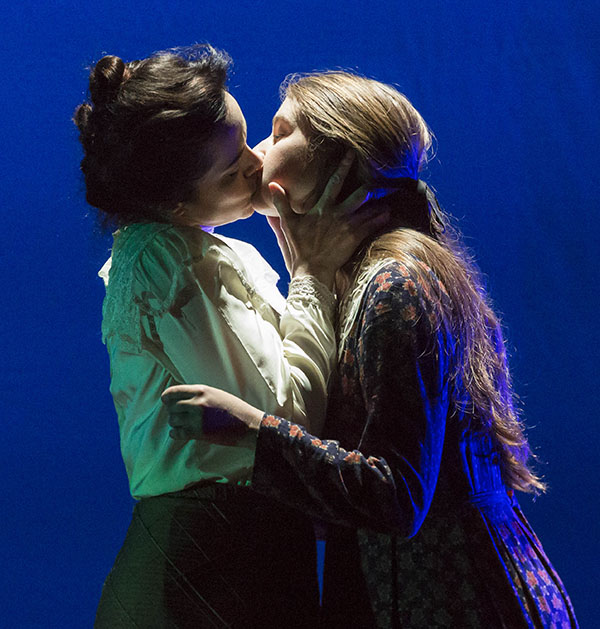
The infamous kiss — Abby Lee (left) and Courtney Spivak in ‘Indecent’ at Indy’s Phoenix Theatre.  (Provided photo by Zach Rosing)

By John Lyle Belden


The Phoenix Theatre has never shied from – in fact it embraces – controversial stage works. With its present production of the Tony-winning drama, “Indecent,” by Paula Vogel, it goes another layer by showing how a popular play shocked Broadway nearly a century ago.

Polish-Jewish writer Sholem Asch wrote just one play, but it became a sensation throughout the Yiddish-speaking world, and even found fame in translation throughout Europe. But when an Americanized “God of Vengeance” went on Broadway (even after playing in New York’s Yiddish theatres with no controversy), the cast and producer were quickly arrested and charged with indecency. Not only was this a Jewish play by a Jew (a troublesome thing in 1923), but it is set in a brothel and features two women falling in love, kissing passionately on stage.

According to program notes, when Vogel was approached about writing this play, she said she immediately pictured a ragged troupe of actors in an attic. That’s who we meet as the lights come up: Lemml the stage manager (played by Nick Jenkins) and his troupe portrayed by Mark Goetzinger, John Goodson, Abby Lee, Jolene Moffatt, Bill Simmons and Courtney Spivak.

Goodson spends most of the narrative as Asch, bringing his surprising new work to a Warsaw writer’s salon, taking it – with Lemml’s help – to the stage, and dealing with the fallout of the indecency trial. He embodies the role well, in all stages from an eager genius to a bitter man focused on the next phase of his writing.

Lee and Spivak are wonderful, portraying women who fall in love both within the play and offstage. Under the direction of Martha Jacobs, their sublime affections bloom beautifully. Phoenix regulars Goetzinger, Moffatt and Simmons are solid, as usual. As for Jenkins, his work is astounding, especially as we come to why we encounter the troupe as they were in the opening scene.

Indecent Lemml-Asch small
Nick Jenkins (left) as tailor-turned-stage manager Lemml and John Goodson as celebrated Yiddish writer Sholem Asch. (provided photo by Zach Rosing)


The multiple languages involved in telling the story are portrayed in part by easy-to-read projected captions. Often the dialogue is in English but the projected cue will say something like “In Yiddish” to maximize understanding and dramatic flow while keeping everything in context.

In the end, it’s like we’ve seen two great plays – we get a Cliff’s-notes understanding of “God of Vengeance (Got fun nekome)” as well as the full measure of Vogel’s work. But you only need to get one ticket. Performances are through July 8 at the Phoenix, now located at 705 N. Illinois St. in downtown Indianapolis; call 317-635-7529 or visit phoenixtheatre.org.

Phoenix: A dream for better women’s lives coming true

By John Lyle Belden

OK, a feminist, a Jew and a Catholic walk into a play…

This is no joke.

In “The Pill,” a drama by Tom Horan in its world premiere run at the new Phoenix Theatre, five women play all the roles – male and female – in the story of the development of the first oral contraceptive.

In the 1950s, Planned Parenthood founder Margaret Sanger (Constance Macy) and former suffragette Katherine McCormick (Jan Lucas) discuss the need to find an “off switch” to pregnancy, something biological that can be taken like an aspirin. Society (mostly men) tells them that such an interference with nature is not possible and not needed. Not accepting either notion, Sanger persuades Dr. Gregory Pincus (Adrianne Villareal) to work on developing a birth-control pill. Once the drug proves effective in animals, these three talk to Dr. John Rock (Jen Johansen) – over Sanger’s objections due to his Catholicism – for help in conducting human trials.

Meanwhile, Sanger receives letters from Sadie Sachs (Jenni White), a young woman who hoped for a career as a nurse, but instead goes through multiple births and miscarriages as her husband insists she continue her “wifely duties.” She is literally dying to get the “secret” that Sanger’s associates are working on.

Directed by Bill Simmons, the play is performed in the round, in the intimate space of the Phoenix’s new black-box Basile Stage (the first production performed there). There is a dreamlike aspect to the flow of the scenes and minimal furniture, with a bit of whimsy and situational humor tempered by Sanger’s hard-edged persistence and Sadie’s heartbreaking visits. It’s a factual fantasia, full of feminine energy. Each scene and vignette is accented by the ringing of a bell; it’s meaning unclear – perhaps reminiscent of an old drugstore pharmacist alerting us the prescription is ready. Still, in moment after moment, it never quite is – Ding! Ding! Ding! We need it, can we have it now?

It would be difficult to praise this cast too much – Johansen, Lucas and Macy are local legends, Villareal a savvy Phoenix veteran, and White (previously seen in Phoenix’s “Barbecue” and starring in Buck Creek Players’ “Nuts”) is incredibly talented as well. They take charge of the material, relieving Simmons of any charges of “mansplaining.” As for the male playwright, it is obvious Horan did his homework, and treats the subject and the people affected with utmost respect.

With The Pill being around and available since the 1960s, it’s too easy a half-century later to take it and its influence on society for granted. This play is important to remind us all – men and women – why this pill was needed and how difficult it was to get it even made. If progress stops, it can be rolled back, or as Sanger says, “We haven’t come this far, to only come this far.”

Performances run through June 10. The Phoenix Theatre is now located at 705 N. Illinois St., Indianapolis, just north of the Scottish Rite Cathedral downtown. Call 317-635-7529 or visit http://www.phoenixtheatre.org.