Bardfest: The wild woman vs. the wacky womanizer — with music

By Wendy Carson

The biggest complaint I have heard from people, regarding Shakespeare’s plays, is trouble following the plot due to the antiquated language. In her Bardfest production of “Taming of the Shrew,” Catalyst Repertory founder and play director/adapter Casey Ross has tackled this issue with the periodic inclusion of pop songs to assist the viewer in comprehending the message of the narrative. Being that the story is fairly well known, this style just makes a fun show even more enjoyable.

For those of you who don’t know the plot: Younger sister Bianca can’t marry until older sister Katherine does. Katherine has no intention to marry anyone. Their father is wealthy and offers a large dowry to whomever can take Katherine off his hands. Cash-strapped playboy Petruchio takes the challenge and not only ends up changing Katherine’s ways, but they both fall in love in the process. There’s also the sub-plot of various suitors trying to secure Bianca’s love.

The setting of this interpretation is a Vegas-style resort casino in the 1970s, with the daughters being cocktail waitresses, their father the owner, and Petruchio a traveling singer looking for a place to earn some money before his debt collectors catch up with him.

Hannah Elizabeth Boswell as the fiery Katherine (or Kate) is a sassy bundle of empowerment, while Davey Pelsue’s Petruchio boldly becomes every bit the hilariously lusty womanizer that the character suggests.

Abby Gilster’s delicate take on Bianca shows the character’s sly knowledge of her situation that is often overlooked in many productions. Bradford Reilly and Robert Webster Jr. as her two suitors (Lucentio and Hortensio), in disguise as tutors, bring a delightful comic desperation in their attempts to secure time with their desired.

Audrey Stonerock adds to the fun as the hottest “Widow” in the club, and Donovan Whitney is at his scene-stealing best as Tranio, a servant pretending to be the rich man while his master plays a humble tutor (see above). The proud – and relieved, when Kate is wed – papa is a charming Godfather-light performance by Tony Armstrong.

All in all, this is a rollickingly great production of a hilarious show. One note though, as we have mentioned previously, this show is not for all ages. Consider it PG-13 at least, though worldly kids might learn a new appreciation for Shakespeare if they see it. Also, bring a few dollars to tip your waitresses and maybe tuck into the clothes of some of the performers.

Performances are Friday, Saturday and Sunday (Oct. 27-29) at the IndyFringe Theatre, 719 E. St. Clair. Find more information at www.indyfringe.org.

Putting the ‘Cat’ in Catalyst

DSC00110
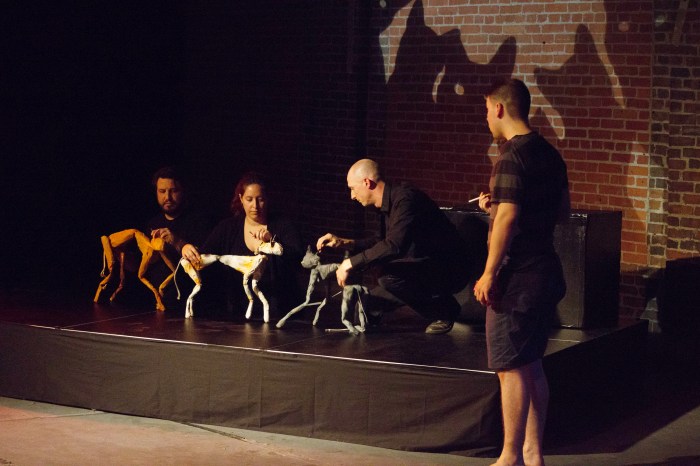
Corbett (Pat Mullen), right, converses with local cats (from left) Orangey (Dane Rogers), Calico (Audrey Stonerock) and Striper (Matt Anderson) in Bennett Ayres’ “Feral Boy,” presented by Catalyst Repertory at Wheeler Arts Community near Indy’s Fountain Square.

By John Lyle Belden*

We’ve likely all seen that internet meme along the lines of “I don’t want to adult today; I want to cat.” Local playwright Bennett Ayres took that idea to its bizarre conclusion in the new drama, “Feral Boy,” presented by Catalyst Repertory on the LongShot Theater stage at Wheeler Arts through May 28.

Corbett (played by Pat Mullen) has graduated college and is expected to take his next step in life. But is it truly his? He excelled in classes, became president of a fraternity, made friends with his bros and had sex with the right girls. Next comes internships and an internet marketing career to make his upper-class parents proud.

But after his roomates (Matt Walls and Donovan Whitney) depart, he starts to see the world through his own eyes – the fish tank in the neighbor’s (Dennis Forkel) window; the cute townie, Betsy (Patty Blanchfield), who works at the nearby convenience store; and especially all the neighborhood’s feral cats.

One night, a feline neighbor, Orangey (Dane Rogers), speaks to him. From then on Corbett draws himself further into their world, meeting gentle Calico (Audrey Stonerock) and their alpha, Striper (Matt Anderson). With the help of Wikipedia’s data on cat behavior, Corbett makes joining their ranks his mission.

The cats are represented by Patrick Weigland’s puppets – elegant slender alley-cat forms with expressive movement provided by their three actors, as well as lurking projected shadows. The portrayals nimbly display their cautious grace and suspicious attitudes expressed in different ways: Rogers’ Orangey blustery and paranoid, Stonerock’s Calico wary but trusting, and Anderson’s Striper cool and controlling.

Mullen excellently guides us through his journey from “imaginary” human to something he sees as more “real.” What appears to others as a man coming apart and abandoning responsibilities, he embraces as a necessary transformation. Blanchfield also shines as the woman caught up in his madness, seeing Corbett as her means of escape – but she can’t follow where he’s going.

The cast also features Sarah Holland Froehlke as Corbett’s mother, and the voices of Jim Tillett, Jolene Moffat and Ayres.

The play itself is an absorbing story, embracing its absurdity – reminiscent of Chuck Palahniuk (“Fight Club”) – without any tongue-in-cheek. Is Corbett delusional? (The cats never speak to anyone else or when he’s around others.) It hardly matters when considering the play’s allegory and questions raised about identity, expectations and how we decide a life’s path. Taken together, director Zach Stonerock and his cast and crew have woven a darkly beautiful drama.

Wheeler Arts Community is located at 1035 Sanders St. in Indy’s Fountain Square neighborhood. For information and tickets, visit uncannycasey.wixsite.com/catalystrepertory or Catalyst Repertory’s Facebook page.

– – –

*Full disclosure: Wendy and I are good friends with Catalyst founder and artistic director Casey Ross, and I helped the production by designing the play program booklet – and making a few copies. But it really IS a good show, just ask Lisa G!

Three great plays at Bardfest

NOTE: As the Word/Eagle is in flux with the renaming and corresponding change in official website, John is putting his reviews here — for now.

By John Lyle Belden

Bardfest had a great opening weekend, and has two more – Oct. 20-23 and 27-30 – at the little Carmel Theatre Company stage, 15 First Ave NE in Carmel’s downtown Arts District (former home to Carmel Community Players).

It was noted in the curtain speech of one show I attended that Indianapolis is about the only major metropolitan area without a Shakespeare Festival. Fortunately, Willie’s plays do reach the boards a few times a year in individual productions around Indy, including a free summer production in White River State Park. But having three shows by the Immortal Bard – only one of which you would likely name off the top of your head if asked to list his plays – is a wonderfully unique experience.

‘KING LEAR’

I confess to missing the First Folio production of “King Lear.” Fortunately, I was familiar with the play and I trust First Folio Productions to pull this classic off more than competently. The title character is played by David Mosedale, and the role of her eldest daughter Cordelia (and a turn as the Fool) by Ann Marie Elloitt, two of the best speakers of iambic pentameter I’ve seen in central Indiana. Sarah Froehlke and Beth Clark as Lear’s devious other daughters are no slouches, either, and excellence is reflected throughout the cast and crew list, including the incredible Tristan Ross.

For those unfamiliar, “Lear” is about a British king who decides to give his kingdom to his three daughters. When the eldest refuses to flatter him, he misunderstands her actions as an insult and banishes her. She ends up in France, and leads an invasion to save her father’s kingdom from the machinations of her sisters. Mix in more madness and intrigue, and end it all tragically, and you have an excellent evening of drama. Which I didn’t have to see, but I highly recommend you do if you can.

‘TWELFTH NIGHT’

I did get a look at Shakespeare’s comedy “Twelfth Night.” It runs down the Bard comedy checklist: Shipwreck? Check. Siblings in distress? Check. Thinly made, but still effective, disguises? Check. Misunderstandings? Check. Wild wooing, leading to unlikely marriage? Check and check!

Perhaps understanding this, Garfield Shakespeare Company and directors Chris Burton and Sam Brandys made this a highly entertaining production by blending conventional pop songs into the narrative – one in particular, you’d swear was written for the play – as well as having instrumentation performed live on stage, especially by Feste, the minstrel Fool, played with perfect charm by Ashley Chase Elliott.

Twin siblings Viola and Sebastian (fraternal, yet perceived by other characters as identical in appearance, performed by Abby Gilster and Spencer Elliott) have washed up on different shores of Illyria after their shipwreck, each presuming the other drowned. Viola disguises herself as a boy and goes to work for the local Duke Orsino (Benjamin Mathis), a single man pursuing the one woman who doesn’t want him, Lady Olivia (Audrey Stonerock). Orsino sends his new servant to deliver his messages of love, but Olivia instead falls for Viola-in-disguise – compounding the “boy”s confusion as s/he is smitten with Orsino. Meanwhile, Olivia’s brother, the drunken Sir Toby Belch (Jay Brubaker) and his dim-witted companion Sir Andrew Aguecheek (Monica Verdouw) are carousing with Feste, an apparently freelance Fool working in both the Duke and Lady’s households. They and Olivia’s servant Maria (Kate Ghormley), play a cruel but hilarious prank on the prideful fellow court member Malvolio (Anthony Johnson), which only adds to the wild goings on – made even wilder when Sebastian makes his way to Olivia’s house.

Confused yet? It’s a Shakespeare comedy; a lot of various characters doing silly things to one another is part of the standard formula. Just relax, let the major groupings and who-loves-who sort themselves out, and just enjoy the ensuing mayhem. And nobody dies – that’s his other plays.

I must heap high praise not only upon every cast name listed above, but also Burton, who takes on various character roles on top of his other duties – he was even fixing the lights before the show.

‘CORIOLANUS’

As for “Coriolanus,” regarding the odd name, if we must get to the bottom (sorry!) of the story it is simply an unfortunate (for modern audiences, though Shakespeare did enjoy a bawdy pun) honorific bestowed on the main character, Caius Marcius (Taylor Cox) to celebrate his victory in battle at Corioli, where pre-Empire Rome defeated the rival Volscians, led by Tullus Aufidious (Ryan Ruckman).

Back in Rome, Marcius is not quiet about his elitist attitude, which doesn’t sit well with the commoners who already blame him (falsely) for a grain shortage. Fortunately, his smooth-talking friend Menenius (Matt Anderson) calms things down, but two Tribunes, Brutus and Velutus (Matt Walls and Paige Scott) observe this and stir up the citizens to oppose Coriolanus’s inevitable ascension to Consul.

Marcius himself doesn’t want the office, but his ambitious domineering mother Volumnia (Nan Macy) insists he take power, while his wife Virgilia (Abby Gilster) agrees, hoping it will keep the lifelong soldier home. But despite his friends and family insisting he stay calm, Marcius verbally explodes, giving the Tribunes the excuse to banish him.

In the second act, the exiled Coriolanus turns to his blood enemy Aufidious, who sets him in charge of the Volscian invasion of Rome. Being the era’s greatest general, Marcius practically brings troops to the gates of the capitol. Desperate to save Rome and win back his friend, Menenius tries to reason with Coriolanus. Finally, his mother, wife and son make their desperate plea. I’m not giving any further spoilers, but it all doesn’t end well.

Cox, who is proving himself to be one of the best actors in Indy, is excellent as his frustratingly complex character. You may not like this Caius Marcius Coriolanus, but you have to respect him. Davey Pelsue applies his matching talent as fellow Roman officer Titus Lartius, a dutiful soldier of inevitably conflicting loyalties. Macy’s is the top performance, a force of nature like a mother wolf who wants to be pack Alpha. You might not want her for a Mom, but you want her on your side. Anderson imbues his glib character with genuine feeling, fearful yet hopeful that his smooth tongue can cure any roughness he encounters. As for Walls and Scott, their villainous portrayal has them practically twirling old-time movie mustaches.

The other “bad guy” of the piece, Ruckman’s Aufidious, stays true to his character and principles, and carries a confident air throughout. Were the audience made of Volscians, he would be the easy hero. This adds to the many gray areas this play works in – not all virtuous win, not all villainous are punished, few are completely noble or evil – which might explain why it so rarely produced.

Unafraid, director Casey Ross gives this story a chance to show us all its complexities. The era portrayed is unspecified, the costumes mildly punk without being distracting, leaving us only with these characters and the drama that plays out among them. Occasional music is modern, but works with the timeless narrative. If you are a fan of great theatre, seeing this “Coriolanus” should be a priority.

For information and tickets to Bardfest, see http://uncannycasey.wixsite.com/bardfestindy.

John L. Belden is Associate Editor at The Eagle (formerly The Word), the central-Indiana based Midwest LGBTQ news source.

Review: Hoosier play brings out actors’ best

By John Lyle Belden

Jim Leonard Jr.’s “The Diviners,” a snapshot of Depression-era Indiana with supernatural overtones, is presented through Sunday by Casey Ross Productions at Carmel Theatre Company (former CCP stage), 15 1st Ave. in downtown Carmel.

The story centers on Buddy Layman (played by Pat Mullen), a youth rendered simple-minded years ago by his near-drowning in the local river, an incident that took his mother’s life. Now a teen, he never bathes and is so afraid of water that he can sense rain hours before anyone even sees clouds, as well as feel it below the ground, allowing him to “divine” locations for wells.

He is cared for by his older sister Jennie Mae (Allyson Womack) and father Ferris (Zach Stonerock), the local engine and bicycle mechanic. Neighboring farmers Basil and Luella Bennett (David Mosedale and Kathryn Comer Paton) see Buddy’s abilities as an asset, as their lives are so tied to the land. In the play’s first scenes, Bennett’s farmhands, Dewey and Melvin (Johnny Mullins and Tyler Gordon) witness Buddy’s “divining” first-hand.

Into this world comes a young drifter, C.C. Showers (Davey Pelsue), looking for work. Ferris hires him, even though the man’s only job experience had been as a preacher, a job he had taken more out of family obligation than spiritual calling, and thus felt no motivation to continue. Showers also takes an interest in Buddy, seeing him more as a troubled person than a human water-detector. In town, they (and we) meet the remaining members of the cast, Bible-thumping shopkeeper Norma Henshaw and her headstrong daughter Darlene (Paige Scott and Heather R. Owens) as well as Goldie Short (Audrey Stauffer Stonerock), who runs the local diner; her bottled soda is about the only liquid Buddy will touch.

Norma’s desire to see the local long-destroyed church rebuilt has her see Showers’ every word and deed as a sign that the man will return to the ministry for their town. His actions to help Buddy with a persistent skin condition become much larger in her eyes, leading to tragic circumstances.

The cast, under the direction of Casey Ross, bring their dramatic A-game. Mullen earns praise for not overselling Buddy’s condition, earnestly delivering the boy’s frustratingly third-person speech and making him feel real. We can see Pelsue’s tattoos peeking out of his shirt sleeves, yet still believe he is a 1930s Kentucky preacher; this is his best performance yet. Mr. Stonerock is convincingly paternal; you can see the zeal gleaming in Scott’s eyes; and Mosedale is rock solid.

To be honest, there are no weak performances at all, which helps keep this play above its potential for cliché or caricature. For comparison, consider the best “Waltons” episode you ever saw, and add water.

For info and tickets, see uncannycasey.wix.com/caseyrossproductions or “caseyrossproductions” on Facebook.

(Also posted at The Word.)