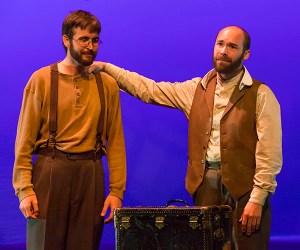
Stellar Summit debut with ‘Silent Sky’

By John Lyle Belden

A century ago, a woman helped revolutionize astronomy, a perfect subject to inaugurate Indy’s new woman-centered theater company, Summit Performance Indianapolis.

“Silent Sky,” by Lauren Gunderson, playing through July 22 on the Basile Stage of the Phoenix Theatre, is the story of Henrietta Leavitt, who, shortly before 1900, joined a team of women working for the astronomy professor at Harvard College (now University) near Boston. Acting as the “Hidden Figures” of their day, Dr. Pickering (who we never meet in this play) calls these women “Computers,” a word not yet attached to the modern device, but still apt. More crudely, they were also referred to as “Pickering’s Harem.”

Though women weren’t allowed to actually use the state-of-the-art telescope, Leavitt (Carrie Ann Schlatter) finds excitement in identifying stars and celestial phenomena on its glass photographic plates. She joins no-nonsense team leader Annie Cannon (Molly Garner) and feisty Scottish immigrant Williamina Fleming (Gigi Jennewien), Pickering’s former housekeeper and his first Computer. They are supervised by the professor’s assistant, Peter Shaw (Adam Tran), a man whose heart really isn’t in his work – until he meets Henrietta.

But the ties of family beckon, as Henrietta’s dear sister Margaret (Devan Mathias) calls her to their father’s Wisconsin home when he falls ill. Even there, she continues her work, seeking to make sense and pattern of the varying brightness in the stars she studies. Margaret tires of her sister’s obsession, and finds solace at her piano – what happens next, as the saying goes, is history.

Produced by Summit founder and Artistic Director Lauren Briggeman and directed by Lori Wolter Hudson, the play makes excellent use of the Basile black-box stage, with audience on three sides, as well as projected starscapes. The props are few but beautiful, including a very functional large desk and Henrietta’s period-appropriate hearing aid. Performances are superb, especially Schlatter expressing Henrietta’s passions and regrets, and Mathias showing Margaret’s tested but true sisterly love. Garner entertainingly transforms from dour to power as a budding feminist. Jennewien is ever the kind mother figure. Tran doesn’t allow his performance to slide into buffoonery, but he is definitely not the smartest “man” in the room.

This sweet drama explores the personal cost of ambition, as well as the struggle to overcome systems set against you. As Henrietta herself says in the play, “Life is about getting appropriately upset.”

Learn about and celebrate the woman who “measured the universe.” Note that the Phoenix is now at 705 N. Illinois St., and curtain times on this stage are 7:30 p.m., 2:30 p.m. Sundays, a half-hour off the mainstage times. For info and tickets visit www.summitperformanceindy.com or www.phoenixtheatre.org.

Asch’s work rises anew in Phoenix production of Vogel’s ‘Indecent’


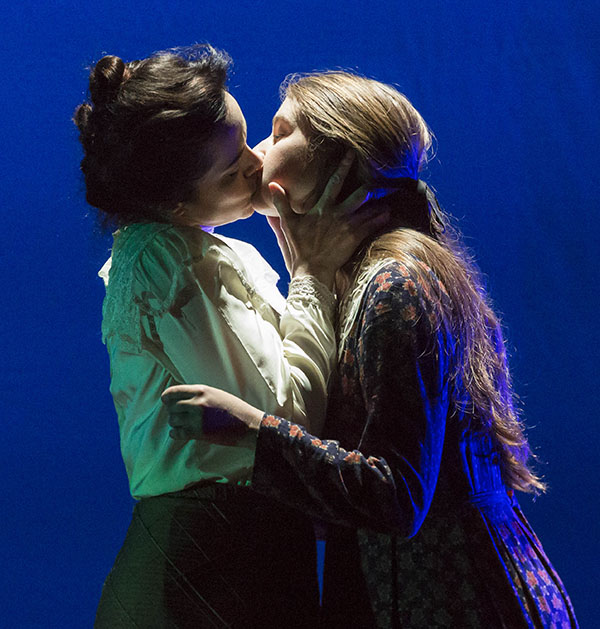
Indecent kiss
The infamous kiss — Abby Lee (left) and Courtney Spivak in ‘Indecent’ at Indy’s Phoenix Theatre.  (Provided photo by Zach Rosing)

By John Lyle Belden


The Phoenix Theatre has never shied from – in fact it embraces – controversial stage works. With its present production of the Tony-winning drama, “Indecent,” by Paula Vogel, it goes another layer by showing how a popular play shocked Broadway nearly a century ago.

Polish-Jewish writer Sholem Asch wrote just one play, but it became a sensation throughout the Yiddish-speaking world, and even found fame in translation throughout Europe. But when an Americanized “God of Vengeance” went on Broadway (even after playing in New York’s Yiddish theatres with no controversy), the cast and producer were quickly arrested and charged with indecency. Not only was this a Jewish play by a Jew (a troublesome thing in 1923), but it is set in a brothel and features two women falling in love, kissing passionately on stage.

According to program notes, when Vogel was approached about writing this play, she said she immediately pictured a ragged troupe of actors in an attic. That’s who we meet as the lights come up: Lemml the stage manager (played by Nick Jenkins) and his troupe portrayed by Mark Goetzinger, John Goodson, Abby Lee, Jolene Moffatt, Bill Simmons and Courtney Spivak.

Goodson spends most of the narrative as Asch, bringing his surprising new work to a Warsaw writer’s salon, taking it – with Lemml’s help – to the stage, and dealing with the fallout of the indecency trial. He embodies the role well, in all stages from an eager genius to a bitter man focused on the next phase of his writing.

Lee and Spivak are wonderful, portraying women who fall in love both within the play and offstage. Under the direction of Martha Jacobs, their sublime affections bloom beautifully. Phoenix regulars Goetzinger, Moffatt and Simmons are solid, as usual. As for Jenkins, his work is astounding, especially as we come to why we encounter the troupe as they were in the opening scene.

Indecent Lemml-Asch small
Nick Jenkins (left) as tailor-turned-stage manager Lemml and John Goodson as celebrated Yiddish writer Sholem Asch. (provided photo by Zach Rosing)


The multiple languages involved in telling the story are portrayed in part by easy-to-read projected captions. Often the dialogue is in English but the projected cue will say something like “In Yiddish” to maximize understanding and dramatic flow while keeping everything in context.

In the end, it’s like we’ve seen two great plays – we get a Cliff’s-notes understanding of “God of Vengeance (Got fun nekome)” as well as the full measure of Vogel’s work. But you only need to get one ticket. Performances are through July 8 at the Phoenix, now located at 705 N. Illinois St. in downtown Indianapolis; call 317-635-7529 or visit phoenixtheatre.org.

BCP musical ‘Dogfight’ a beautiful story about ugly intentions

By John Lyle Belden

Don’t let the title fool you: “Dogfight,” the musical at Buck Creek Players though June 17, has nothing to do with dogs, or cruelty to animals – just cruelty to humans.

An early collaboration by the composers of “Dear Evan Hansen” that played off-Broadway in 2012, this musical is based on the 1991 film, “Dogfight,” starring River Phoenix and Lili Taylor.

In the early 1960s, young Marines in San Francisco – one day before shipping out to be “advisors” in Vietnam – engage in the Corps tradition of a “dogfight.” Each of the men pays into a pot awarded to the one who brings the ugliest girl to a dance party. Eddie Birdlace (Nathan Wilusz) and his fellow “B’s,” Boland (Levi Hoffman) and Bernstein (Scott Fleshood) search the streets for “dates,” but Eddie has no luck, until he stops at a coffeeshop and hears a girl singing as she plays guitar. Rose (Addison R. Koehler) appears plain and a little plump, so Eddie asks her to the party. Happily naive, she looks forward to her first real date, while Eddie starts to feel his conscience give him second thoughts. Suddenly the other B’s meet up with them, and the “fight” is on – “Sempre Fi, do or die.”

Though I risk ruining the premise of the play, or giving away its subtext, I must note that Koehler is beautiful in every way – her voice, her stage presence, her brave portrayal, the way she shines through even the plainer outfits she wears. More amazing, she’s still in high school (making her close to the age of the character she plays), so her potential is just beginning to show.

Wilusz makes a fine Marine, struggling with being a young gentleman in the hours before reverting to the ways of the warrior. Hoffman and Fleshood are also excellent, in their own rough ways. It must be noted that these men all swear like, well, Marines – BCP advises the show should be considered “R” rated. Also notable is Shelbi Berry in roles including Marcy, a girl who sees the event as a way to cash in; Emily Tritle as stoic Ruth Two Bears; and Onis Dean in various roles throughout.

The story goes deeper than the titular contest, of course, though the theme of cruel judgement based on appearance still resonates today. One clue to how much the world is about to change is in the date this takes place, and with little known about what’s happening in Southeast Asia, the men going there are in their own way as naive as the women they had set out to fool. This is also a sweet love story, as Eddie makes a valiant effort to salvage his budding relationship with Rose. The songs are well-written and well-placed, even if they aren’t hit showtunes.

Another great show directed by D. Scott Robinson, “Dogfight” is worth making your way out to the playhouse at 11150 Southeastern Ave. (Acton Road exit off I-74 southeast of Indy). Call 317-862-2270 or visit www.buckcreekplayers.com.

Phoenix: A dream for better women’s lives coming true

By John Lyle Belden

OK, a feminist, a Jew and a Catholic walk into a play…

This is no joke.

In “The Pill,” a drama by Tom Horan in its world premiere run at the new Phoenix Theatre, five women play all the roles – male and female – in the story of the development of the first oral contraceptive.

In the 1950s, Planned Parenthood founder Margaret Sanger (Constance Macy) and former suffragette Katherine McCormick (Jan Lucas) discuss the need to find an “off switch” to pregnancy, something biological that can be taken like an aspirin. Society (mostly men) tells them that such an interference with nature is not possible and not needed. Not accepting either notion, Sanger persuades Dr. Gregory Pincus (Adrianne Villareal) to work on developing a birth-control pill. Once the drug proves effective in animals, these three talk to Dr. John Rock (Jen Johansen) – over Sanger’s objections due to his Catholicism – for help in conducting human trials.

Meanwhile, Sanger receives letters from Sadie Sachs (Jenni White), a young woman who hoped for a career as a nurse, but instead goes through multiple births and miscarriages as her husband insists she continue her “wifely duties.” She is literally dying to get the “secret” that Sanger’s associates are working on.

Directed by Bill Simmons, the play is performed in the round, in the intimate space of the Phoenix’s new black-box Basile Stage (the first production performed there). There is a dreamlike aspect to the flow of the scenes and minimal furniture, with a bit of whimsy and situational humor tempered by Sanger’s hard-edged persistence and Sadie’s heartbreaking visits. It’s a factual fantasia, full of feminine energy. Each scene and vignette is accented by the ringing of a bell; it’s meaning unclear – perhaps reminiscent of an old drugstore pharmacist alerting us the prescription is ready. Still, in moment after moment, it never quite is – Ding! Ding! Ding! We need it, can we have it now?

It would be difficult to praise this cast too much – Johansen, Lucas and Macy are local legends, Villareal a savvy Phoenix veteran, and White (previously seen in Phoenix’s “Barbecue” and starring in Buck Creek Players’ “Nuts”) is incredibly talented as well. They take charge of the material, relieving Simmons of any charges of “mansplaining.” As for the male playwright, it is obvious Horan did his homework, and treats the subject and the people affected with utmost respect.

With The Pill being around and available since the 1960s, it’s too easy a half-century later to take it and its influence on society for granted. This play is important to remind us all – men and women – why this pill was needed and how difficult it was to get it even made. If progress stops, it can be rolled back, or as Sanger says, “We haven’t come this far, to only come this far.”

Performances run through June 10. The Phoenix Theatre is now located at 705 N. Illinois St., Indianapolis, just north of the Scottish Rite Cathedral downtown. Call 317-635-7529 or visit http://www.phoenixtheatre.org.

The beat goes on for CCP with ‘Ragtime’

By John Lyle Belden

RAGTIME: A modification of the march with additional polyrhythms coming from African music, usually written in 2/4 or 4/4 time with a predominant left-hand pattern of bass notes on strong beats and chords on weak beats accompanying a syncopated (“ragged”) melody in the right hand. Ragtime is not a “time” in the same sense that march time is 2/4 meter and waltz time is 3/4 meter; it is rather a musical style that uses an effect that can be applied to any meter. – from Wikipedia

How appropriate that “Ragtime” is the title of the first show for Carmel Community Players after losing its previous home: The beat of the theatrical season goes on, as events turn ragged with a stage search resulting in a nicer venue – though outside Carmel and further from Indy. A large and immensely talented cast and crew adapt quickly, making props and actor movement serve a larger space, singing their hearts out as seasonal health issues threaten.

Yet it all works.

It is worth the drive up to Noblesville to see this compelling glimpse of an America that, a century later, still casts its shadows on the events and issues of today.

This Broadway musical is largely the story of three families – Harlem musician Coalhouse Walker Jr. (Ronald Spriggs) and Sarah (Angela Manlove), the woman who fell in love with him; Jewish Eastern European immigrant Tateh (Thom Brown) and his daughter (Ali Boice), seeking any possible opportunity in America; and the wealthy white suburban family finding themselves in the middle of upsetting but inevitable social, historic and cultural changes. Being what would now be called the faces of “white privilege,” in this latter group we don’t even bother with names: Father (Rich Phipps), Mother (Heather Hansen), her Younger Brother (Benjamin Elliott), Grandfather (Duane Leatherman) and Little Boy (Lincoln Everitt).

We also see some people who one might actually meet in early 1900s New York, including anarchist Emma Goldman and Civil Rights icon Booker T. Washington, powerfully portrayed by Clarissa Bowers and Bradley Lowe, respectively. Celebrities include Harry Houdini (Jonathan Krouse), popular magician and escapist; and Evelyn Nesbitt (Molly Campbell), the Kardashian of her era.

Appropriately, the most critical roles give the strongest performances – Manlove and Spriggs bringing us to tears, Brown confronting crushing problems with wry humor, and Hansen struggling to reconcile her “perfect” life into a more just worldview.

Also notable are Guy Grubbs as unrepentant bigot Willie Conklin, and – at the opposite end of character appeal – little Gavin Hollowell steals our hearts in the final scene.

In addition, I must give kudos to Everitt for, as frequent narrator and our future-generations point of view, ably carrying such a big role on his small shoulders.

This musical has seen some controversy, particularly in its period-appropriate use of the N-word, but the horrors of racism should disturb us, and in the end this is not just a story about groups, but individual men and women, like us, dealing with the still-continuing evolution of this thing we call America.

Performances are this Friday through Sunday (April 27-29) at Ivy Tech Community College auditorium, 300 N.17 th St., Noblesville. Information and tickets at carmelplayers.org.

Observe a witness to history at the IRT

By John Lyle Belden

An exceptional treat for theatre fans and history buffs, the James Still masterpiece, “Looking Over the President’s Shoulder,” has returned to the Indiana Repertory Theatre through May 6.

Aspiring opera singer – and proud native of Lyles Station, Indiana – Alonzo Fields took one of the few jobs available to a black man in Boston in the 1920s: a household servant. Then a chance encounter with First Lady Lou Henry Hoover leads to a position at the White House, where he ascends to Chief Butler. As he says in the play, Fields planned to only work through the winter before returning from Washington to Boston and his music – “That ‘winter’ lasted 21 years.”

David Alan Anderson transforms fully into Fields, recounting his career to us as he waits for the bus after his last day at the White House. Through him – and Still’s researched work, based in part on Fields’ memoir – we gain an insight into the lives and personalities of four presidents and their wives, as well as visiting British prime minister Winston Churchill.

The political scene is largely beside the point, though the racist policies of of the era can’t be ignored. Fields remembers encountering segregated facilities, and reflects on President Harry Truman’s orders to integrate the military. Serving through the end of Herbert Hoover’s term and 12 years of Franklin D. Roosevelt gave him a unique perspective on the White House during the Great Depression, as well as World War II.

The most striking thing about the narrative is the focus on the presidents and their families, their humanity and the way they conducted themselves in public and private. In this context, the Executive Mansion becomes a fully fleshed-out character as well. Adding to the context of history we may already know, we gain a deeper understanding of the Hoovers, the Roosevelts, the Trumans, and the Eisenhowers. And, in turn, we get the measure of this man before us, our unassuming hero, as well as the hard-working staff who invisibly keep the White House running smoothly, allowing our leaders to do their jobs as best they can.

The IRT is at 140 W. Washington St. in downtown Indy, next to Circle Centre. For information and tickets, call 317-635-5252 or visit www.irtlive.com.

IndyFringe: ‘Jubilee in the Rear View Mirror’

By John Lyle Belden

These things happened.

We must never forget that. These things happened.

Jubilee, Mississippi, does not exist, and “Jubilee in the Rear View Mirror,” the short drama by Garret Mathews that had a run at the recent IndyFringe festival, is fiction, but racial strife and murderous bigotry in Mississippi in the 1960s were real. These things happened.

Kates (portrayed by Donovan Whitney) represents the various college students – black, like him, or even white – who volunteered as civil rights workers, helping disenfranchised Southern blacks to register and vote. People who put up with derision, verbal and even physical attacks, from white residents who declared them “outside agitators” and an enemy to society. People who landed in a Southern jail cell, like Kates, speaking on a college level with a cellmate who barely finished high school, only adding to the layers of difference between them, yet trying to hard to bridge.

These things happened.

Buell (Clay Mabbitt) represents the Southerners who don’t feel things are quite right, but it’s the world they were born into. Perhaps they play along because it keeps you out of trouble. Perhaps they find other ways to act out at the world, like getting drunk and attacking a traffic light, landing in jail next to this nig… this outsider.

These things happened.

Tadpole (Sam Fields) seems like an unreal stereotype, but we all know someone like him, and in the rural South 50 years ago, there weren’t public services to care for people with mental challenges, but local folks would adopt them and take care of them. But what if your caretaker is in jail?

These things happened.

Spottswood (Kevin C. Robertson) represents the face under the KKK hood, the men invested in the racist status quo, who didn’t even see non-whites as human. Men who not only defied the outsiders, but reveled in the fact that they could kill them, and likely never face justice.

These things happened.

The jail Guard (Dustin Miller) represented the common go-along/get-along citizen. They just don’t want trouble, and really don’t feel comfortable with strangers coming in and upsetting things.

These things happened.

These actors, under the direction of Susan Nieten, do an excellent job of breathing life into these archetypes, making them human – all human – and standing before us, bringing the arguments and ideas of the time to life, presenting “all sides” better than the bluster of a present-day politician reveals. They bring to life Mathews’ imagined scenes, based on numerous interviews of people who were there, in real Southern towns.

These things happened.

And when you see this show, wherever it next gets staged – and you should – even with a different cast and director, and you see what its events lead to, remember:

These things happened.

For information on the inspiration for “Jubilee” visit Mathews’ website, www.pluggerpublsihing.com.

Indy companies expertly flesh out Richard III’s twisted skeleton

By John Lyle Belden

In 2012 came the stunning news of a human skeleton discovered under a parking lot in Leicester, England. It was the twisted body of what history and legend regard as a twisted soul, King Richard III. This setting opens the Catalyst Repertory/First Folio production of William Shakespeare’s play about the infamous monarch at the IndyFringe Theatre.

In what would be the last years of England’s Wars of the Roses between contesting royal families, King Edward IV is sick and dying. Richard, the Duke of Gloucester, is reviled for his crippled body, which brings on his sour attitude. The clever Duke decides if he can’t look like a hero to gain the crown, he’ll be the villain. But between him and the throne are George, Duke of Clarence; nobles faithful to Edward’s wife, Queen Elizabeth; and the child heir, Edward, Prince of Wales.

Some people are going to have to die.

Matt Anderson completely transforms into Richard, with the help of costume artist Linda Schornhorst (whose excellent work adorns the whole cast). This, coupled with Anderson’s complete control of his body and expressions, keeps him the focus of every scene. He leers towards the audience, proudly revealing to us his schemes. He lurks like a menacing vulture as his plans unfold. He contorts himself into whatever ingratiating pose will fool those around him as he continues grasping to take, then desperately hold power.

Carey Shea anchors the play as doomed Clarence, heroic Richmond and the archaeologist who bridges the gap between history and today. Jay Hemphill is charming as the Duke of Buckingham, Richard’s cousin and co-conspirator until he becomes cursed with a conscience.

Also notable are the women of the play, Allison Clark Reddick as Elizabeth; Christina Howard as Lady Anne, Richard’s unwilling bride (and a few scenes as Lord Grey); Nan Macy as the Duchess of York, Richard’s disappointed mother; and Casey Ross as Queen Margaret, widow of a previous monarch and bitter prophet.

The children – Dalyn Stewart as Prince Edward and Lex Lumpkin as his cousin, the Duke of York – are both sharp.

And kudos to Doug Powers, Matthew Socey, Ryan Reddick, Kevin Caraher, Matthew Walls, Mark Cashwell and John Mortell in various roles. Thanks to Glenn L. Dobbs’ direction and the play being adapted to two hours, in two acts, by Dobbs, Ross and Ben Power, it’s not hard to follow the sprawling cast of characters. (Richard has many of them killed, anyway.)

Plays like this are always apropos in an era of political turmoil, and performances this good are worth seeing at any time.

“Richard III” runs through July 9 at the IndyFringe Basile stage, 719 E. St. Clair (by the intersection of St. Clair, College and Massachusetts Ave.). See indyfringe.org for info and tickets.

Girl seeks protection from the forces of history in ‘Golem of Havana’ at Phoenix Theatre

By John Lyle Belden

Just the title of the new musical playing at the Phoenix Theatre, “The Golem of Havana,” suggests the complex nature of its story, but the various threads weave together into a fascinating historical tapestry, set in Cuba during its 1950s Revolution.

The title entity is dreamed up by a Jewish girl in Havana, inspired by the legends her family brought with them from eastern Europe (having survived the Nazis and gotten away from Soviet occupiers). Rebecca (Lydia Burke) creates a homemade comic book about the Golem – a giant clay guardian crafted and enchanted by a Rabbi to protect the people – that followed the Jews across the ocean to continue its service.

Her father, Pinchas (Eric J. Olson), is a struggling tailor living on dreams, while her mother, Yutka (Lori Ecker), tries to keep his ambitions grounded. Meanwhile, family friend and government policeman Arturo (Carlos Medina Maldonado) promises to help them through his connections.

Rebecca befriends the family’s black Cuban maid, Maria (Teneh B.C. Karimu), who worries about the fate of her son, Teo (Ray Hutchins), who has joined the Revolutionaries. While praying for her son’s safe return, Maria introduces Rebecca to her faith in the goddess Yemaya, and at a time when the Hebrew god seems so distant, this local deity feels more responsive when it seems, at first, that things are changing for the better.

But the faith and humanity of all are tested when Teo arrives at the family home, injured, and hunted by authorities seeking to execute him. Yutka confronts conflicting urges to protect the man or to turn him away and protect her family, while remembering what happened to her and her sister (Betsy Norton) when they were betrayed to the Nazis in Hungary.

The cast also features Wheeler Castaneda, Rob Johansen, and Paul Nicely as Cuban President Fulgencio Batista.

The songs and music (under the musical direction of Karimu) flow nicely with the story. Under the steady hand of director Bryan Fonseca, the gripping drama of people caught in the changing tides of history keeps the focus on the heroic and tragic stories of individuals rather than the background events – a good thing, since neither the doomed Batista regime nor the imminent Castro victory are celebrated by history.

Burke gives us an appealing and endearing character. Hutchins reveals the pain that informs Teo’s choices. Olson’s happy optimist and Ecker’s pragmatic pessimist show how opposites do attract and make a family we can root for. Maldonado also does well in his layered portrayal of a man of mixed loyalties. Nicely shows his skill in revealing just enough humanity in a cold-hearted character to make him truly frightening.

As Rebecca says, stories matter, and “The Golem of Havana” matters not just as a Jewish story or a Cuban story, but also as a human story. It runs through July 16 on the Phoenix mainstage at 749 N. Park Ave. (corner of Park and St. Clair) in downtown Indy. Call 317-635-7529 or visit phoenixtheatre.org.

Zach & Zack’s ‘Great Bike Race’ returns to TOTS

By John Lyle Belden

I’ve heard friends in Fringe shows say it’s hard to constrain a whole play to 40 minutes, so it must have been a relief for writer-director Zack Neiditch to let “The Great Bike Race.” his 2014 IndyFringe comedy hit, play out a full 70 minutes on the stage of Theatre on the Square, weekends through June 24.

The Race of the title is the 1904 Tour de France. After the success of the inaugural Tour the previous year, the ’04 bicycle race attracted a lot of attention and opportunistic riders. It became infamous for its widespread sabotage and cheating – including a competitor using a train as a “shortcut.”

Bringing that action to today’s audiences, Neiditch and Zach Rosing present a “cleverly anachronistic” (their characters told me to write that) play with the aid of antic actors, pantomime bicycles and a big projection screen.

Much of the Fringe cast returns, including Frankie Bolda as noble teen Henri Cornet. Paige Scott and Ben Asaykwee are the race front-runners and bitter rivals, Hippolyte Acoutrier and Maurice Garin. Carrie Bennett Fedor and Evan Wallace are Jean-Baptiste DuFortunac and Llucien Portier, two men who like each other very, very much. Sonia Goldberg is the only woman playing a woman, Alois Catteau, but she’s pretending to be a man. John Kern and Craig Kemp play other riders, while Josh Ramsey plays three from three different countries, whom at one point all get in an argument while trying to beat each other to the front of the pack.

For those who’ve seen it before, this version doesn’t feel padded-out at all. It’s still manic fun throughout its course, complete with contested Victory Dance.

Who wins? You do, by getting to see this hilarious show (whether again, or for the first time). Call 317-685-8687 or visit tots.org for tickets.